Chongqing at Night: Cyberpunk Views, Cruises & Neon Lights
If you think Chongqing China is just another sprawling megacity during the day, wait until the sun drops behind the mountains. Chongqing at night is something else entirely — a gravity-defying maze of stacked skyscrapers, glowing bridges, and light trails that feel ripped straight from a sci-fi movie. The city climbs up the hills in every direction, and when all those windows and LEDs flicker on at once, the whole place transforms. You’re not just looking at a skyline. You’re standing inside one.
People travel across the globe for this view. Some call it the most futuristic cityscape on Earth. Others say chongqing night has a cyberpunk soul that no other city can touch. Truth is, both descriptions fit — and experiencing chongqing at night firsthand is the only way to understand why. This guide walks you through exactly where to go, when to show up, and how to make the most of every glowing moment, from cliffside observation decks to AR-powered river cruises and hidden photo spots the locals keep quiet about.

- Why Chongqing Looks Like a Cyberpunk City at Night
- Best Night View Spots to Catch the Skyline
- South Bank: Where Photographers Go to Escape the Crowds
- Cruising the Two Rivers After Dark
- Neon, Drones, and Light Shows
- Late-Night Bites and the Chongqing Nightlife Scene
- Practical Tips for Exploring Chongqing at Night
Why Chongqing Looks Like a Cyberpunk City at Night
Scroll through Instagram or Reddit for five minutes and you’ll see the label everywhere: chongqing cyberpunk city. It’s not a marketing gimmick. The visual DNA of this place — the vertical stacking, the neon density, the trains cutting through buildings — aligns with everything the cyberpunk aesthetic was built on. And all of it intensifies after dark.
Start with the elevation. Chongqing sits where the Yangtze and Jialing rivers meet, surrounded by steep hills. Buildings don’t sprawl outward the way they do in flat cities. They pile upward, with one structure’s 20th floor level with another building’s ground entrance. When chongqing at night lights up, this vertical chaos glows like a massive circuit board. You’ll see monorail trains glide directly through the middle of residential towers, headlights blazing, against a backdrop of illuminated high-rises stretching into the dark. That’s the chongqing futuristic city experience in one frame.
Then there’s the light itself. The commercial districts around Jiefangbei and Guanyinqiao are wrapped in giant LED screens cycling through saturated electronic colors. Over in Jiaochangkou, a place called Deyi World crams so many neon signs into one intersection that photographers nickname it “Blade Runner brought to life.” The air smells like Sichuan peppercorns and grilling meat. Horns echo off the buildings. It’s chaotic, dense, and impossibly alive — exactly why the chongqing cyberpunk city label refuses to fade, and why chongqing at night has become a bucket-list item for photographers worldwide.
The Sujiaba Interchange Observation Deck (Nan’an District, Metro Line 3 to Tongyuanju Station) pushes this aesthetic to its limit. Picture a red circular overpass suspended 50 meters in the air, offering a 270° unobstructed view. After dark, the continuous stream of headlights and taillights tracing the spiral ramp looks exactly like an energy conduit from a sci-fi film. Show up between 18:30 and 20:00 to catch the transition from blue-hour dusk to full darkness — one of the most surreal ways to experience chongqing at night.
Another monster of infrastructure — the Huangjuewan Interchange — has five stacked layers, 20 ramps, and connects eight directions at once. Its highest point rises 37 meters, roughly 12 stories. When traffic lights stripe every level simultaneously, the whole structure glows like an illuminated skeleton.
One metro station deserves a paragraph of its own. Haitangxi Station (Nan’an District, Loop Line) is widely recognized among photographers as “the train station that most resembles Blade Runner.” Trains on the Loop Line emerge from dense clusters of postmodern residential towers, with the glittering Yuzhong Peninsula skyline and the gold-tinted Sheraton Twin Towers shimmering in the background.
For the best shot, walk to the glass window at the far end of the platform in the direction of “Sigongli.” Use a telephoto lens to compress the tracks, the distant Raffles City complex, and the Twin Towers into a single frame. The sweet spot is 19:30 to 21:30 — all the landscape lighting is on, train frequency is high, and office building interior lights are still blazing. Stand here for ten minutes and you’ll understand why chongqing at night generates more camera shutters than almost any other urban landscape in Asia.
Best Night View Spots to Catch the Skyline
If you came to Chongqing specifically for the chongqing night view, you’re in the right place. The city has observation decks at every altitude — rooftop skyscrapers, mountainside pavilions, riverbank parks. The trick is knowing which one matches the kind of photo (or memory) you want when chongqing at night spreads out beneath you.
High-Rise Observation Decks in Yuzhong District
Cloud Eye (atop the United International Building) is a 360° open-air observation platform and a filming location for the CCTV Spring Gala segment “Moving Clouds and Flowing Water.” At 520 meters above sea level, it features a striking red suspended staircase that’s become an Instagram magnet. From here, the entire chongqing skyline at night stretches across both rivers in every direction. Tickets start at 58 CNY (about 8 USD). Open 09:30 to 22:30.
Raffles City Exploration Deck · Sky Paradise sits inside the horizontal crystal corridor 250 meters above ground — China’s first “horizontal skyscraper.” The 270-degree glass observation deck on the 47th floor gives you Yuzhong, Jiangbei, and Nan’an all at once. Look down through the transparent glass floor and you’ll see the two rivers merging directly beneath your feet. Tickets start at 118 CNY (about 17 USD). Open 10:00 to 22:00.
WFC Huixian Tower Observation Deck (75th floor, Jiefangbei core area) is the pick for a quieter indoor experience. Floor-to-ceiling glass faces the river confluence head-on. It’s ideal for capturing the depth of the cityscape and the slow light trails of cruise boats far below. This is one of the purest chongqing aerial view vantage points in the city center, and on a clear night the sense of floating above chongqing at night is genuinely disorienting in the best way.
Ground-Level Classics: Hongya Cave and Its Surroundings
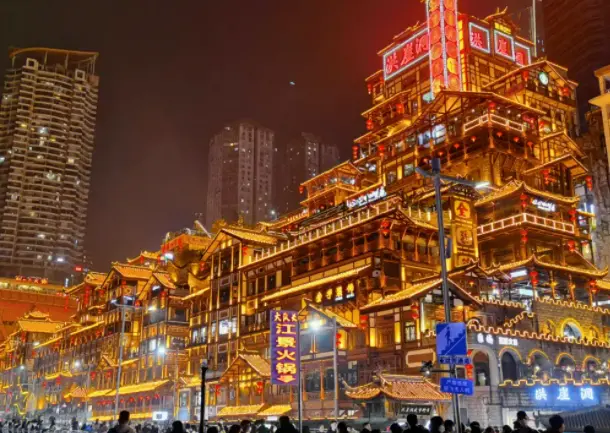
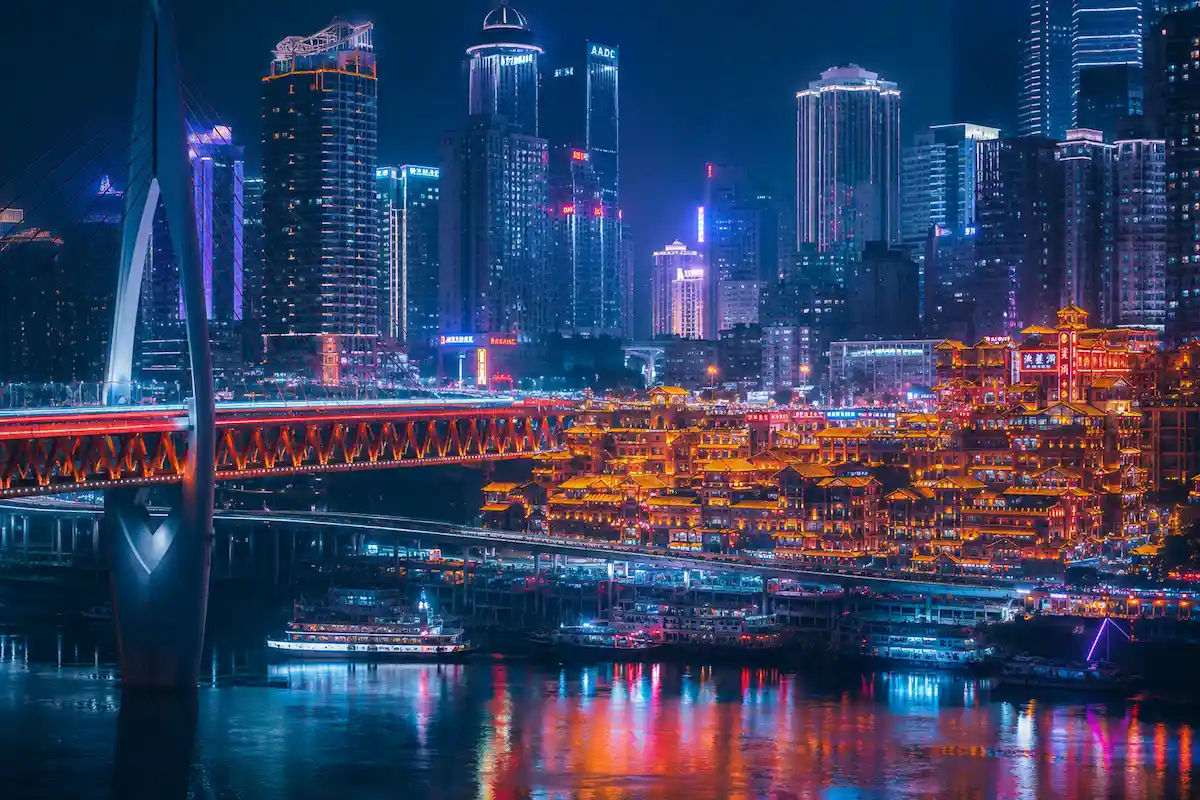
Hongya Cave (No. 88 Jialing River Binjiang Road, Yuzhong District) is the postcard shot everyone recognizes — tiers of stilted buildings clinging to the cliffside, glowing gold and amber against the dark river. The lights switch on at 18:30. The panorama is at its best from 19:30, and the lights stay on until about 23:00 (with slight seasonal adjustments). The Qiansimen Bridge illuminates from 19:30 to 22:30.
Don’t just stand at the entrance and call it done. The four best vantage points for soaking in chongqing at night from this area, arranged from closest to farthest:
- Hongya Cave ground level (Level 1) — Step outside and look up for the dramatic upward-angle shot.
- Daijia Lane Cliff Walkway — A side-angle perspective of the full architectural complex from the cliffside footpath.
- Qiansimen Bridge pedestrian walkway — The classic overhead shot. This is where most of the viral “Spirited Away” comparisons are photographed.
- Jiangbeizui Riverbank Park — Cross the Jialing River to the opposite bank and shoot Hongya Cave with its reflection on the water. Professional photographers swear by this spot for its compositional depth.
A practical heads-up: if you shoot from Jiangbeizui Riverbank Park and leave after 22:00, walk about 15 minutes to the entrance of Huanyu Tianxia residential compound to hail a ride. Ride-hailing apps struggle to pinpoint pickups right at the riverbank that late at night.
South Bank: Where Photographers Go to Escape the Crowds
Cross the river to the Nan’an side and the whole perspective shifts. Instead of standing inside the glow, you’re stepping back to watch it breathe. This is where the chongqing night skyline reveals its full shape, and where chongqing at night feels less chaotic and more cinematic.
Nanshan Yikeshu (One Tree) Observation Deck is the classic. Perched on Nanshan Mountain, it faces the Yuzhong Peninsula straight on. Arrive during blue hour — that 20-minute window before full darkness — and watch the city transition from a deep indigo silhouette into a sea of gold. It gets packed in peak season, so claim your spot at least 30 minutes early.
Chongqing Socialist Academy (Nanbin Road, navigate to “Chongqing Socialist Academy”) is a lesser-known gem. The terraced layout creates dramatic depth, and the neon glow at night has drawn comparisons to the futuristic cityscapes from Ghost in the Shell. Unlike the wide panorama from Nanshan, this angle feels like a medium close-up — the towers are nearer, the light details sharper. You’ll feel pulled right into a giant illuminated screen. Best from 19:00 to 21:00.
Longmenhao Old Street (Nanbin Road, Metro Line 6 to Shangxinjie Station) layers old and new in a single frame. Traditional stilted buildings with gray-green roof tiles and white walls are outlined in warm light after dark. Above them loom the Dongshuimen Bridge and the electric skyline of Yuzhong Peninsula. Two spots not to skip: Lanyue Platform for a 270° view of the bridge and city lights, and Xiahaoli Panoramic Platform where a waterfall cascades into the frame with the city glowing behind it. Visit between 19:30 and 22:30.
Changjiahui Viewing Platform (No. 69 Taichang Road, next to Changjiahui Shopping Park) offers an open, unobstructed panorama of both rivers and all four banks. If a drone show happens to be scheduled, this is one of the best places to watch it — you’ll face Raffles City and the Grand Theatre directly across the water. Best time: 19:30 to 21:30.
Huguishi Huajie Park (Nan’an District) packs an incredible amount into one composition: the dense skyscraper cluster of Yuzhong Peninsula dead ahead, the Yangtze Cableway gliding slowly across the left side of the frame, and Raffles City thrusting upward on the right. Hongya Cave, Qiansimen Bridge, and the two-river confluence all fit into a single shot here — making it one of the most efficient places to capture chongqing at night in a single frame.
For something slightly different, City Sky Canopy · Leyou Sightseeing Tower (top floor of Crown International Twin Towers, Block A, Nanbin Road) sits 200-plus meters up with a 360° view. Beyond sightseeing, they run “Clifftop Above the River,” “Cloud Walk,” and “Cloud Slide” experiences if you want a dose of adrenaline with your chongqing lights. Shoot for 18:30 to 20:00 to capture the full sunset-to-night transition.
Two more worth the trek: Laojun Cave, a Daoist temple dating back to the Sui and early Tang dynasties, spirals up the mountainside in the shape of a mysterious character. The top pavilion, Yuhuang Tower, overlooks the entire peninsula. Pair it with an afternoon hike and stay for the evening view. Tushan Viewing Deck welcomes visitors from 18:30 to midnight — drive early if you’re self-driving, the road gets jammed.

Cruising the Two Rivers After Dark
Staying on land only gets you half the story. A chongqing night cruise changes the pace entirely — the city scrolls past you at a walking speed from the water, and everything you saw from the observation decks suddenly feels three-dimensional. When chongqing at night surrounds you from every direction on the dark river, it’s an entirely different sensation than peering at it from a fixed viewpoint.
Traditional two-river cruises depart from Chaotianmen Square and loop around the Yangtze-Jialing confluence. The journey takes 45 to 60 minutes. The boat drifts past Hongya Cave, Qiansimen Bridge, the Chongqing Grand Theatre, and Raffles City in sequence. The shoreline chongqing neon lights shift colors constantly, breaking into scattered reflections across the dark water. Take the last departure of the evening for a quieter deck, cooler air, and the sensation of floating through a glowing labyrinth.
Practical details for the traditional cruise:
- Departure piers: Hongya Cave Pier (Classic Cruise), Chaotianmen Pier No. 9 (Jinbi Cruise), Chaotianmen Pier No. 7 (Premium Cruise)
- Off-peak pricing: Classic / Jinbi Cruise — 128 CNY (about 18 USD, originally 168 CNY / 24 USD); Premium Cruise — 158 CNY (about 23 USD, originally 198 CNY / 28 USD)
- Ticket channels: “大美重庆” WeChat official account or the “拼周末” platform
- Pro tip: In 2025, two-river cruise passenger volume hit 3.7 million trips, with 89% of those being night cruises. In Q1 2026 alone, 974,000 passengers boarded, and the average night cruise occupancy exceeded 77%. Book ahead — walk-up tickets vanish fast.
AR Night Cruise: Chongqing in an Instant
If a standard chongqing evening cruise feels too passive, there’s a next-generation option that turns chongqing at night into an augmented-reality playground. Rokid, in collaboration with Chiguang Qiyuan and Changhang Two-River Cruises, has launched an AR-enhanced experience that layers digital storytelling over the real skyline. Traditional river cruises have long faced an industry-wide problem — repetitive “sightseeing plus commentary” formats with a rebooking rate below 8%. This AR version aims to fix that.
Put on the Rokid AR glasses and a digital companion guides you through the whole journey, explaining the geography behind the two-river confluence, the history of Ba-Yu culture, and the stories behind each landmark. Two AR theatrical themes — one cyberpunk, one ink-wash Chinese painting style — play out across the river surface, blending seamlessly with the real scenery. There are also virtual interactive elements like bottle-tossing ceremonies and blessing rituals woven into the ride. The glasses run on Rokid’s in-house optical display, spatial positioning, and real-time rendering technology, tuned specifically for the motion of a moving boat.
If you’re into tech or simply want a chongqing night time experience unlike anything you’ve tried before, this is the one to book.
Neon, Drones, and Light Shows
Chongqing at night goes well beyond static building illumination. During major holidays and festivals, the area above the two-river confluence becomes the stage for a large-scale chongqing drone show. Hundreds of drones lift off in formation, spelling out “Hello Chongqing,” hot pot, monorail trains, and other local icons against the dark sky. Paired with the ground-level chongqing neon lights, the effect is a fully three-dimensional light experience — one layer on the buildings, one on the water, one in the air.
Drone performances typically start between 20:00 and 21:00. Exact schedules depend on local cultural tourism announcements, so check a few days before your visit. For photography, set up a tripod at Chaotianmen Square or along Nanbin Road. Use a long exposure to capture both the drone light trails and their reflections on the water in a single frame. The Changjiahui Viewing Platform is a solid front-row seat if a show coincides with your trip.
Don’t overlook the smaller architectural light details either. Hong’en Temple Forest Park (Jiangbei District, Hong’en Road, Metro Line 5 to Dashiba Station, Exit 3A) houses Hong’en Pavilion, one of the highest observation points in the main urban area with a 360° view across multiple districts. Beyond the panorama, the pavilion itself is stunning up close — upturned eaves, glazed tiles, crimson pillars, and painted carvings all glowing under dedicated lighting. The catch: lights switch off at 21:00, a full two hours earlier than Hongya Cave. Don’t arrive late.
Late-Night Bites and the Chongqing Nightlife Scene
By the time you’ve chased skyline views for a few hours, you’ll be hungry. Chongqing nightlife splits into a few distinct flavors depending on your mood, and it’s one of the most underrated things to do in Chongqing after the sun goes down.
Jiu Jie (Nine Street) in Jiangbei is the main bar strip — packed with clubs, live music venues, and crowds that keep going past 2 a.m. If you want the raw energy of chongqing at night after midnight, this is where you’ll find it. For something quieter, the riverside bars and restaurants along Nanbin Road pair a relaxed drink with an unobstructed chongqing skyline at night right outside the window. No crowds, no rush, just the lights across the water.
For food that tastes best at 1 a.m. with river breeze on your face, head to the night market stalls near Jiefangbei or the barbecue strip along Jiaochangkou. Skewers of grilled meat, spicy noodles, and cold beer flow until 3 a.m. The combination of Sichuan peppercorn heat, charcoal smoke, and the distant glow of the peninsula sums up chongqing china at night better than any observation deck ever could.

Practical Tips for Exploring Chongqing at Night
- Best season for night views: The best time to visit Chongqing for clear night skies is late spring (April–May) and autumn (September–October). Summer nights are warmer and the lights run longer, but humidity can haze up distant views. Winter brings crisp air and the earliest sunsets — lights pop on around 18:30.
- Hongya Cave lighting schedule: 19:30–23:00 for the main complex; 19:30–22:30 for Qiansimen Bridge. These shift slightly by season.
- Hong’en Pavilion lighting schedule: 19:30–21:00. Shorter window than other landmarks — plan accordingly.
- Getting around at night: The Chongqing metro runs until roughly 23:00 on most lines. After that, ride-hailing apps are your best bet, though pickups can be tricky in crowded areas like Hongya Cave and the riverbank parks. Walking 10–15 minutes away from the busiest zones usually saves you both time and surge pricing.
- Tripods and photography: A compact tripod is worth the weight for long-exposure shots of light trails, drone shows, and river reflections. Most observation decks allow them, though extremely crowded spots like Nanshan Yikeshu may have space constraints during peak hours.
- Where to stay: Book hotels in Chongqing near Jiefangbei or Nanbin Road if night photography is your priority — you’ll spend less time commuting and more time shooting. Nanbin Road hotels often come with river-view rooms that let you watch chongqing at night from your window.
- Crowd levels: Weekday nights are significantly quieter than weekends. If you’re visiting during a Chinese public holiday (especially National Day in early October or Spring Festival), expect every spot on this list to be packed.
The Yangtze Cableway glides across the dark water as the city flickers beneath you. A train cuts through a residential tower, lights blazing. Somewhere down an alley, a hot pot boils over a gas flame. This is what thousands of people fly halfway around the world to see. Go find your spot before the lights come on — the best view in Chongqing at night is the one you’re standing in front of, wide-eyed, for the very first time.
Ke Ping — Founder, Chongqing Travels
Certified China Travel Specialist · Certificate details
This guide can become your real trip
Instead of figuring out the mountain city's vertical maze alone, let me and our team build your perfect Chongqing trip — from Hongyadong's neon lights to the best late-night hot pot.
📋 Plan My Chongqing Trip