How to Ride the Chongqing Metro & Subway in 2026: Fares, Tickets & Tips
Last October I took two first-time visitors from Jiefangbei to Liziba, and I assumed the hard part would be explaining how to pay. It wasn’t. What actually stopped all three of us at the gate was a much simpler problem: we were standing at the wrong exit.
A lot of Chongqing metro stations share one name but spread across several exits. One exit opens onto a hillside, another spits you out by the river. Step out of the wrong gate at “Liziba Station” and you are standing in a completely different city. That was the moment it clicked for me: the Chongqing subway is not just a way to move from A to B. It climbs hills, threads through apartment blocks, tunnels into rock, and drops more than 90 meters underground. For a first-timer, the tricky part of riding the Chongqing subway was never the ticket. It was learning the system’s personality. The Chongqing subway does things no other transit system dares to.
This is the guide I wish my two friends had read before they landed. How to ride it, how to pay, what it costs, and the mistakes to avoid. Once you learn how to navigate Chongqing this way, the subway becomes the single most useful tool in Chongqing public transport — and honestly, one of the best free shows in China.
- How to Ride the Chongqing Subway: The Five-Step Process
- The Chongqing Metro System: A Monorail Kingdom Built for a Mountain City
- How to Pay: Three Ways, Step by Step
- Which Way Is Cheapest? Cards, Tokens, and Passes Compared
- Don't Make These Mistakes: Etiquette & Common Slip-Ups
- Common Questions
- The Pre-Trip Checklist
How to Ride the Chongqing Subway: The Five-Step Process
Whether you are heading to Ciqikou, Hongya Cave, or Jiangbei Airport, every ride follows the same five steps. Skim this first, then we’ll unpack each one.
- Find the right entrance. Look for the round “Chongqing Rail Transit” (CRT) logo outside. Check your exit number on the yellow sign — different gates lead to different streets.
- Pass security. Bags go through the X-ray belt. Power banks get pulled out for a separate look. No big deal.
- Pay to get in. Scan a phone QR code at the gate, or buy a single-journey token and tap it.
- Get on the right side. Check the platform direction sign before you board. Follow the transfer signs at interchange stations.
- Exit cleanly. Scan or drop your token at the exit gate, then follow the yellow signs to the correct exit.
Fares & Payment at a Glance
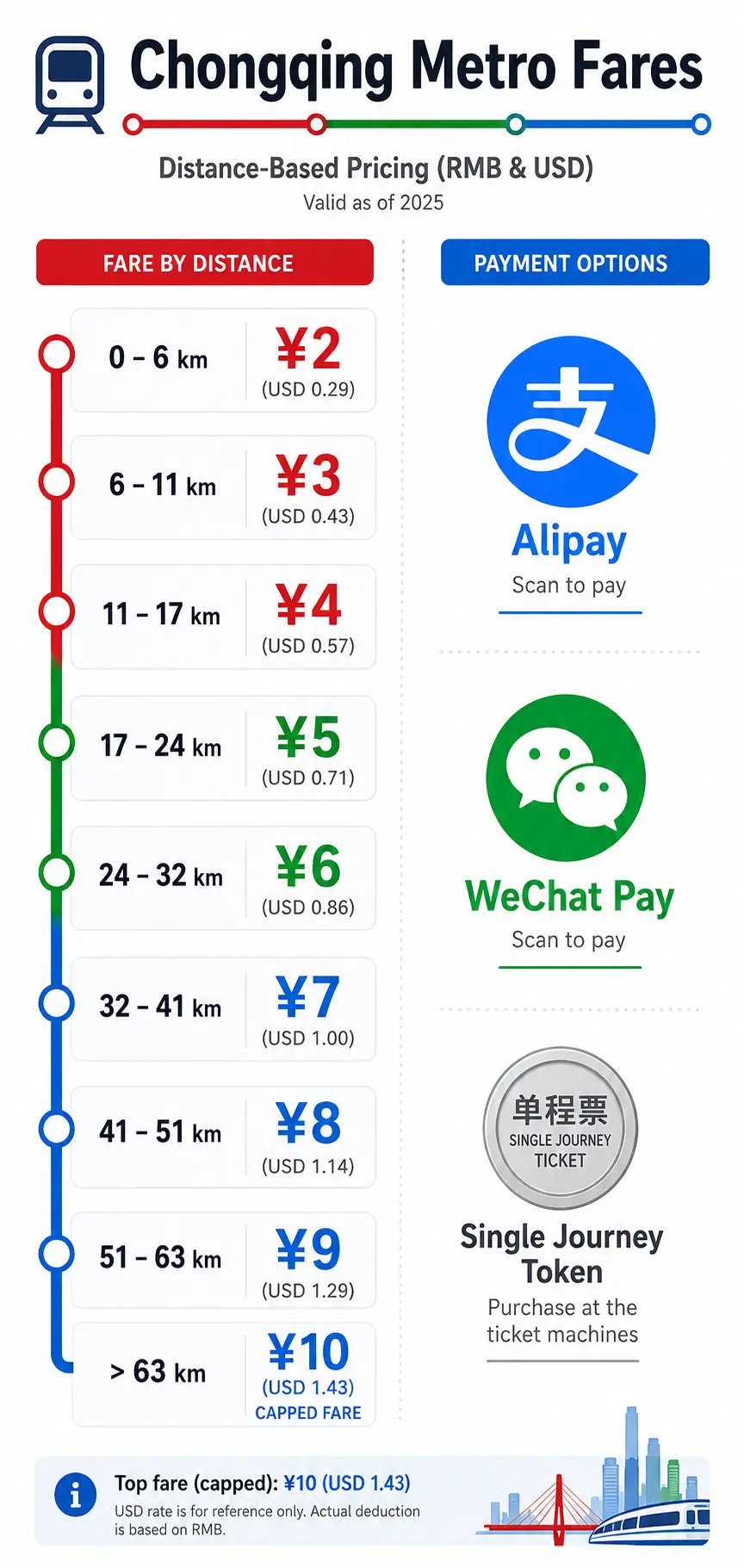
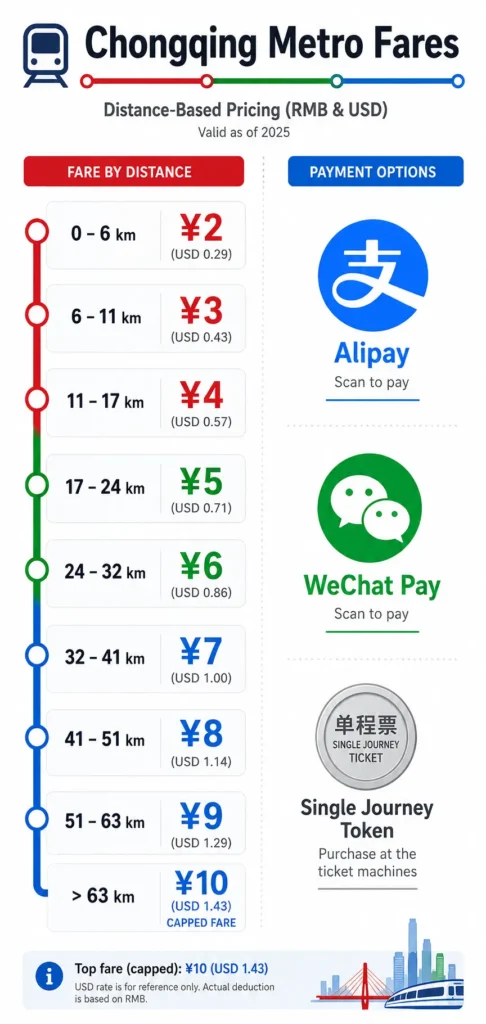
Fares are distance-based, capped at ¥10 (about USD 1.43).
| Distance | Fare |
|---|---|
| 0–6 km | ¥2 (about USD 0.29) |
| 6–11 km | ¥3 |
| 11–17 km | ¥4 |
| 17–24 km | ¥5 |
| 24–32 km | ¥6 |
| 32–41 km | ¥7 |
| 41–51 km | ¥8 |
| 51–63 km | ¥9 |
| Over 63 km | ¥10 (cap, about USD 1.43) |
For foreign visitors, three payment methods actually matter:
| Method | Best for | What to know |
|---|---|---|
| Alipay / WeChat QR code | Anyone with the app | Link an overseas Visa/Mastercard, verify with your passport, scan and ride. Fares cap at ¥10 with no fees. |
| Official Chongqing metro app (Yuchangxing) | Longer stays, live route info | Full features, but one more app to install and verify. |
| Single-journey token (the Chongqing metro card) | No phone, occasional rides | Ticket machines take small bills and coins only (¥5/¥10/¥20). Big bills go to the staffed counter. |
The short version: if you’re visiting, scan with Alipay or WeChat. No app? Keep small bills for a token — the Chongqing metro card is the no-phone fallback.
The Chongqing Metro System: A Monorail Kingdom Built for a Mountain City
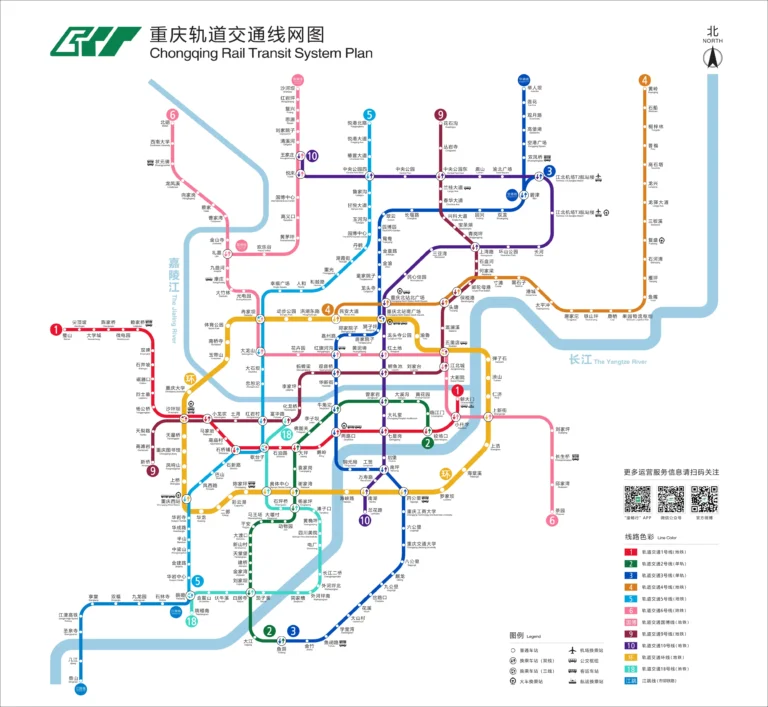
The official name is the Chongqing Rail Transit, or CRT — the Chongqing metro system as it’s formally known. It opened in 2004 and has grown into the sixth-longest metro system in the world — and the single largest monorail network on the planet. For anyone planning to get around, it’s the backbone of Chongqing public transport. Right now it runs 13 lines, including a few suburban and intercity routes.
What makes the Chongqing subway unlike almost anywhere else is the mix: Lines 2 and 3 are straddle-beam monorail (what locals casually call the Chongqing light rail), while the rest run as conventional subway. The Chongqing monorail climbs steeper grades and squeezes through tighter spaces, and the Chongqing monorail network is the largest of its kind anywhere on Earth — which is why you’ll see trains hugging the cliffs along the Jialing River, or driving straight through an apartment block.
The Core Lines Worth Remembering
| Line | Type | Route | Why tourists use it |
|---|---|---|---|
| Line 1 | Metro | Chaotianmen ↔ Bishan | Hongya Cave (Xiaoshizi), Ciqikou (Ciqikou) |
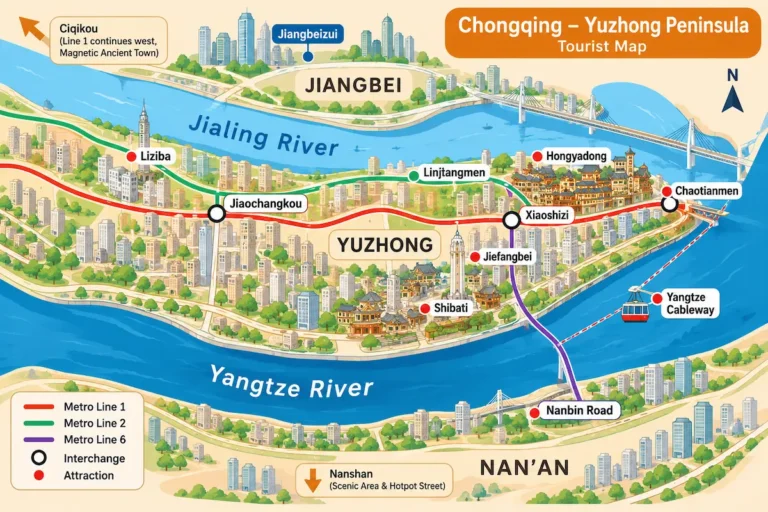
| Line 2 | Monorail | Jiaochangkou ↔ Yudong | Liziba “through-the-building”, Linjiangmen (Jiefangbei/Hongya Cave) |
| Line 3 | Monorail (main) | Yudong ↔ Jiangbei Airport T2 | Guanyinqiao, Jiangbei Airport T2 |
| Line 6 | Metro (main) | Chayuan ↔ Beibei | Xiaoshizi, Grand Theatre, Hongtudi (deepest station) |
| Line 9 | Metro | Gaotanyan ↔ Huashigou | Ciqikou / Guanyinqiao transfers |
| Line 10 | Metro | Lanhualu ↔ Wangjiazhuang | Jiangbei Airport T2/T3, Hongtudi |
| Line 18 | Metro | Fuhualu ↔ Tiaodengnan | Sichuan Fine Arts Institute (Huangjueping) |
| Loop Line | Metro | Circular | Chongqing West, Chongqing North South Square, Danzishi |
The suburban routes (Jiangtiao, Bishan extension) head to outlying districts like Jiangjin and Bishan, which most tourists never need. For the full line map and every station, see our full Chongqing Metro Map — this guide stays focused on how to actually ride the Chongqing subway, and you’ll find more on getting around Chongqing there.
Operating Hours
Core city lines run a uniform 06:30–23:00: the Loop Line and Lines 1, 2, 3 (main), 4, 5, 6 (main), 9, 10 and 18.
Branch and suburban lines close earlier:
- Guobo Line (Line 6 branch): 06:30–22:30
- Airport Line (Line 3 branch): 06:30–22:30
- Jiangtiao Line: 06:30–21:30
- Bitong Line / Bishan extension: 06:10–21:00
Two things to remember. Those 06:30 and 23:00 times are for the departure station, not every station along the line. And on major holidays (New Year’s Day, May Day, National Day, Dragon Boat Festival) or big concert nights, the core lines often push the last train to 23:30 or even midnight. Always double-check before a late night out.
How to Pay: Three Ways, Step by Step
If you only sort out one thing before your trip, make it payment. The good news in 2026: you don’t need cash, and you don’t need a Chinese bank card.
Option 1: Alipay or WeChat QR code (easiest)
- Verify your identity in Alipay or WeChat using your passport.
- Link an overseas credit or debit card — Visa, Mastercard, JCB, Discover, and Diners Club all work. No local bank account required.
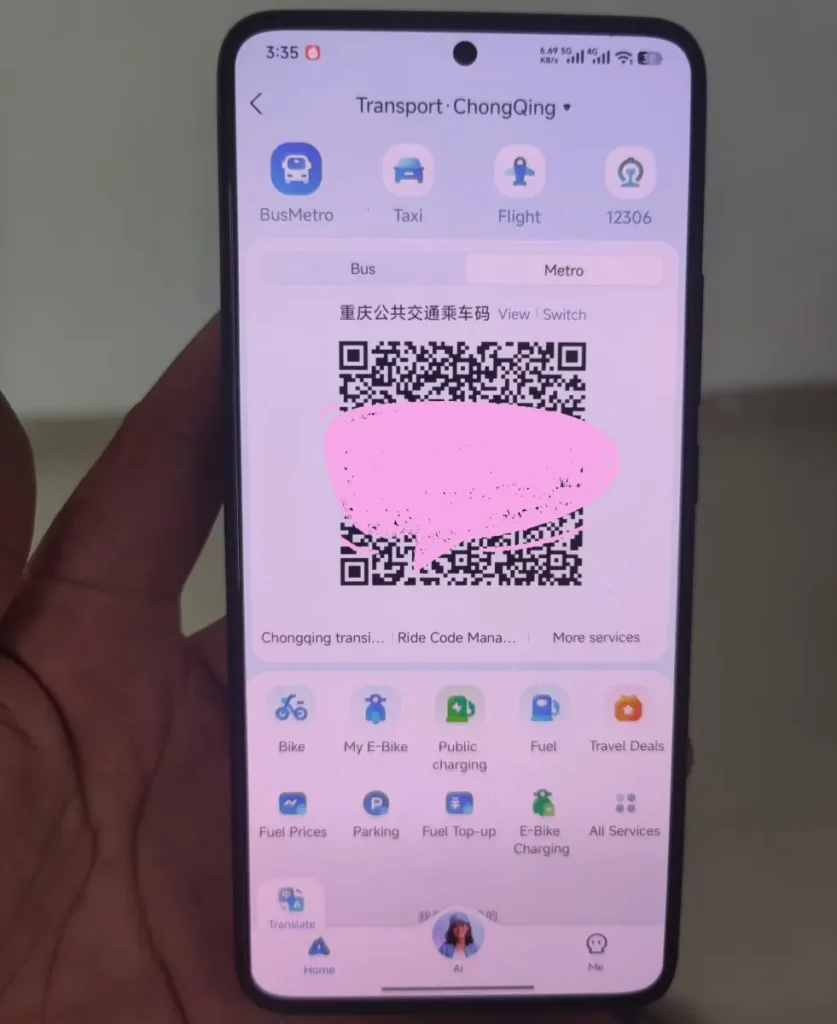
- In Alipay: open the app → tap “Transport” → switch the city to “Chongqing” → choose “Metro” → claim the card. You’ll now have a Chongqing subway QR code.
- Tap the QR code on the gate scanner to enter, and again to exit. The fare deducts automatically.
Here’s the hidden perk: overseas cards under ¥200 per transaction skip the foreign-exchange fee. Since a ride caps at ¥10, you’ll pay essentially zero fees the whole trip.
Option 2: The official Chongqing metro app (Yuchangxing)
The official Chongqing metro app does the most — live arrivals, full route planning. But for visitors it means downloading one more Chinese app and going through another verification step. Unless you’re staying a while and constantly checking routes, Alipay or WeChat is the easier path. (Honestly, the Chongqing metro app is overkill for a three-day trip.)
Option 3: Single-journey token
Riding once or twice, or your phone died? Buy a single-journey token — a coin-sized plastic card. This is the Chongqing metro card for travelers who’d rather skip the apps.
- Ticket machines (TVMs) accept small bills and coins only: ¥5, ¥10, ¥20.
- Holding a ¥50 or ¥100 note? Go to the staffed Customer Service Center.
- Tap in, and drop the token into the exit gate when you leave. Don’t lose it.
Entering, Security, Boarding, Exiting
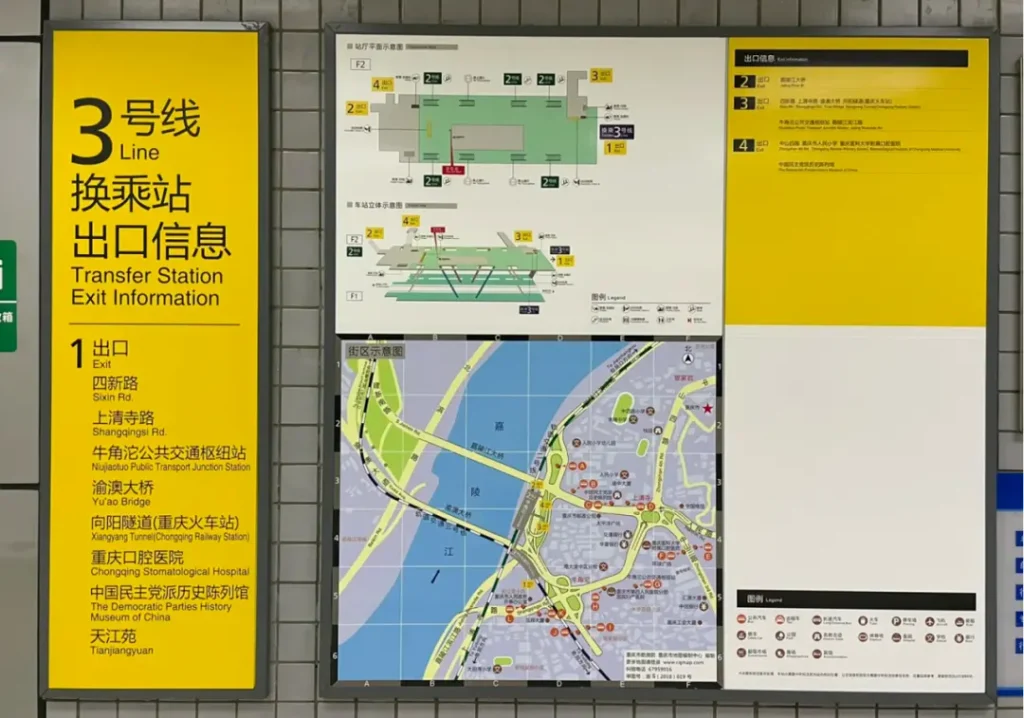
Enter. Spot the round Chongqing Rail Transit (CRT) logo at street level. Each station entrance has a board with the line color, line number, Chinese name, pinyin, and exit number (like “Gate 5”). Know your line and exit before you head down.
Security. Bags and suitcases go through the X-ray. Power banks (within the usual capacity limit) come out for inspection. It’s quick — set your bag down and follow the flow.
Gate. Scan your code or tap your token. Walk through when the gate opens.
Platform. This is a mountain city, so platforms aren’t always on one level. Follow the line-color and transfer signs, and double-check the direction. Board the wrong way? Get off at the next station and cross to the other side.
Ride and exit. Announcements and screens run in Chinese and English. Watch your stop, scan or drop your token at the exit, and follow the yellow signs to the right gate.
Which Way Is Cheapest? Cards, Tokens, and Passes Compared
| Ticket | Price | Where to buy | Best for |
|---|---|---|---|
| Single-journey token | ¥2–¥10 by distance | Ticket machine (small bills) or counter | One or two rides |
| Alipay / WeChat code | By distance | Phone | Most visitors — the easiest |
| 1-day pass | ¥18 (about USD 2.57) | Staffed counter only, passport | Lots of rides in one day |
| 3-day pass | ¥45 (about USD 6.43) | Staffed counter only, passport | Three days of nonstop exploring |
The Day Pass, Explained
Staying about three days and planning to ride everywhere? A Chongqing metro pass pays for itself — it’s the only pass worth buying if you ride daily.
- 1-day pass, ¥18: unlimited rides for 24 hours from your first scan.
- 3-day pass, ¥45: unlimited rides for 72 hours from your first scan.
Buy it only at a station’s Customer Service Center with your passport — the machines and apps don’t sell it. The card is unregistered, can’t be recharged, and won’t be collected when you leave, so it doubles as a souvenir. Quick math: ride four or five times in a day and you’ll beat the ¥18 price; hop between two or three sights daily for three days and the 3-day pass is a clear win. (It’s also a tidy fit for a 7-day Chongqing itinerary.)
Don’t Make These Mistakes: Etiquette & Common Slip-Ups
After years of riding the Chongqing subway, these are the things locals wish visitors would stop doing:
- Dragging big luggage through rush hour. Mornings 7:30–9:00 and evenings 17:30–19:00 crush stations like Jiefangbei, Guanyinqiao, and Shapingba. With heavy bags, skip those windows or head for the middle of the car.
- Picking the wrong exit. One exit on a hill, another by the river. Decide your street before you enter, and match the landmarks on the yellow exit board when you leave.
- Bagging a seat with luggage. Keep bags at your feet or on the rack. Don’t take a seat for them.
- Eating and drinking onboard. Not allowed. A bottle of water is usually fine, and smoking never is.
- Missing the announcements. Confirm your direction before boarding and listen for the bilingual stop calls. Some lines run “short-turn” trains in peak hours that reverse mid-route — if everyone files off, follow them and wait for the next train.
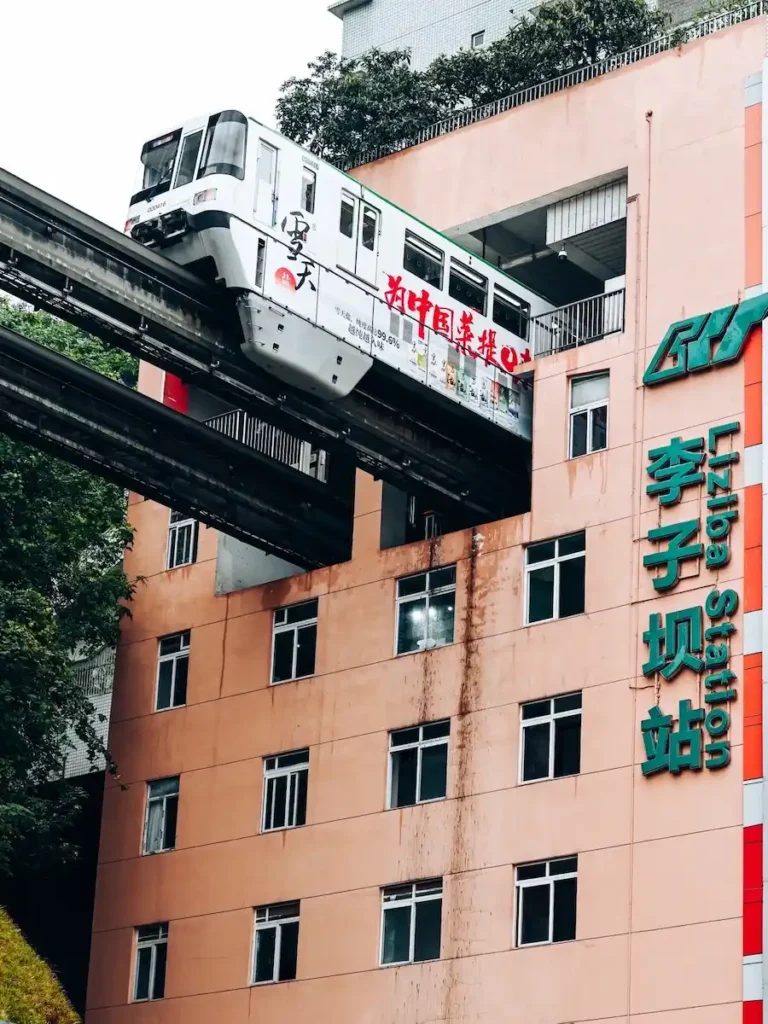
Liziba Station: The Train Through a Building
The most famous stop on the entire Chongqing subway is Liziba Station on Chongqing metro Line 2 — the one where a train drives straight through a residential tower. To feel it yourself, ride Line 2 and stand at the front or rear of the train. For the classic photo, head down to the observation platform below and look up as the train slips into the building. Liziba is what most people mean when they talk about the Chongqing light rail, and the Chongqing metro through building clip was filmed right here — the one shot that made this system famous worldwide. Ride the Chongqing metro Line 2 once and you’ll see why it’s the city’s best-known piece of rail transit.
Hongtudi Station: 94 Meters Underground
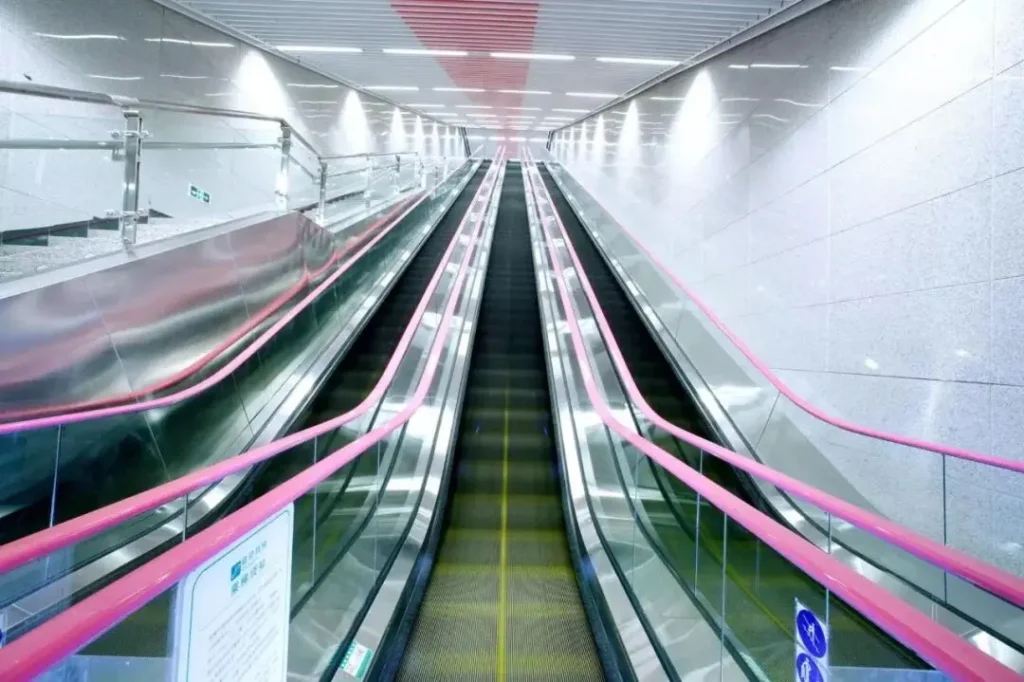
If Liziba is the magic above ground, Hongtudi is the shock below. The Line 10 Hongtudi Station sits 94.4 meters deep — roughly 31 floors down, one of the deepest metro stations in China. The station runs 91 escalators, and reaching the Line 10 platform means riding eight long escalators, a journey of about 8 to 10 minutes. First-timers often look up and wonder if they’ll ever reach the bottom. It’s the Chongqing subway’s own monument to the city’s vertical obsession — and the best proof of just how far the Chongqing subway depth really goes. Across town, the Chongqing monorail runs the same vertical logic above ground, and the Chongqing metro through building spectacle is its most famous cousin.
Common Questions
- Can foreigners pay with cash? Yes, but small bills only. Machines take ¥5/¥10/¥20 notes and coins; for ¥50 and ¥100, use the staffed counter.
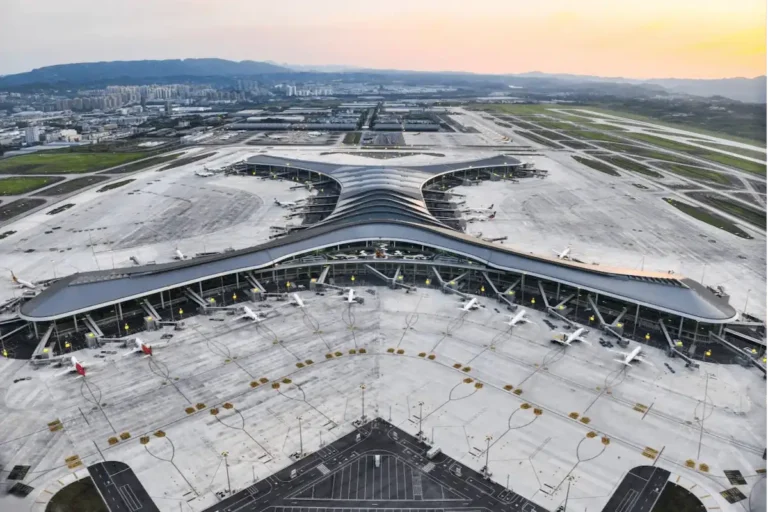
- Does the metro reach the airport? Yes. Line 10 goes to Jiangbei Airport T2 and T3; Line 3 also reaches T2. Airport transfers and intercity rail are covered in our transport guides.
- Can I tap my foreign credit card on the gate? No. Chongqing gates don’t take Visa/Mastercard directly — link the card to Alipay or WeChat and scan the QR code instead.
- Is it doable with luggage or a stroller? Big stations have elevators, but it’s a mountain city and some exits climb. Look for an elevator exit before you go down, and dodge rush hour.
- How late does it run? Core lines run about 06:30–23:00; Guobo and Airport branches close around 22:30, Jiangtiao around 21:30. Holidays often extend to 23:30 or midnight.
The Pre-Trip Checklist
- Install Alipay or WeChat and verify with your passport
- Link an overseas Visa/Mastercard (no Chinese bank card needed)
- Claim your metro QR code, city set to Chongqing
- Carry a few ¥5/¥10/¥20 notes in case your phone dies
- Riding a lot? Grab a 1-day (¥18) or 3-day (¥45) pass at the counter with your passport
- Check your exit number before you enter
- Avoid rush hour (7:30–9:00 / 17:30–19:00) with big luggage
- Want the through-the-building shot? Ride Line 2, stand at the front or rear
Sort the rest once you arrive — and if you’re still deciding where to base yourself, we’ve got you covered on where to stay in Chongqing and planning your Chongqing trip. Master how to navigate Chongqing by metro and the whole city opens up. After all, a place whose trains drive into buildings and burrow 90 meters underground is not going to let you ride it quietly. Lean in.
Ke Ping — Founder, Chongqing Travels
Certified China Travel Specialist · Certificate details
This guide can become your real trip
Instead of figuring out the mountain city's vertical maze alone, let me and our team build your perfect Chongqing trip — from Hongyadong's neon lights to the best late-night hot pot.
📋 Plan My Chongqing Trip