Chongqing Pronunciation Guide: How to Pronounce Chongqing Correctly (With Audio & Chinese Tones)
You’re at airport immigration. The officer glances up. “Where are you headed?”
“Chon-king,” you say.
A pause. Then a polite, slightly confused smile.
This is not a hypothetical. Almost every first-time traveler to Chongqing freezes on this word. Ten letters, two syllables — and native English speakers get the Chongqing pronunciation wrong roughly 100% of the time. The problem isn’t you. It’s that pinyin spelling rules and English reading instincts run on completely different wiring.
Here’s the good news: five minutes with this guide, and your Chongqing pronunciation will outclass 95% of foreign visitors. (If you’re already researching how to say it, you’re probably planning a Chongqing trip — smart move.) We’ll break it down syllable by syllable, with audio, tone tricks, and a dead-simple mouth-shape technique.
- Why Getting "Chongqing Pronunciation" Right Matters
- Quick Breakdown: How to Pronounce Chongqing
- Chinese Tones Made Simple
- The Smile Technique: Lock In Your Chongqing Pronunciation Without Linguistics
- Common Mistakes When You Pronounce Chongqing
- What Does "Chongqing" Mean?
- How Locals Say It: Dialect vs. Standard Mandarin
- Beyond Pronunciation: Why Book the Flight
- FAQ
Why Getting “Chongqing Pronunciation” Right Matters
Chongqing is no longer a hidden gem.
According to official data from the Chongqing Immigration Inspection Authorities, the city welcomed over 760,000 international visitors in a single year — a staggering 30% year-on-year surge in inbound and outbound travelers. Trip.com consistently ranks Chongqing as a top-trending destination for travelers from Malaysia, Thailand, Singapore, and South Korea.
From the neon-drenched stilt houses of Hongya Cave to the limestone peaks of Wulong Karst, this “8D Magical City” is climbing global wishlists faster than ever.
Here’s what that means for you: every time you say “Chon-king,” a local has to do a mental translation before responding. Nail the pronunciation Chongqing deserves, and you skip that friction entirely.
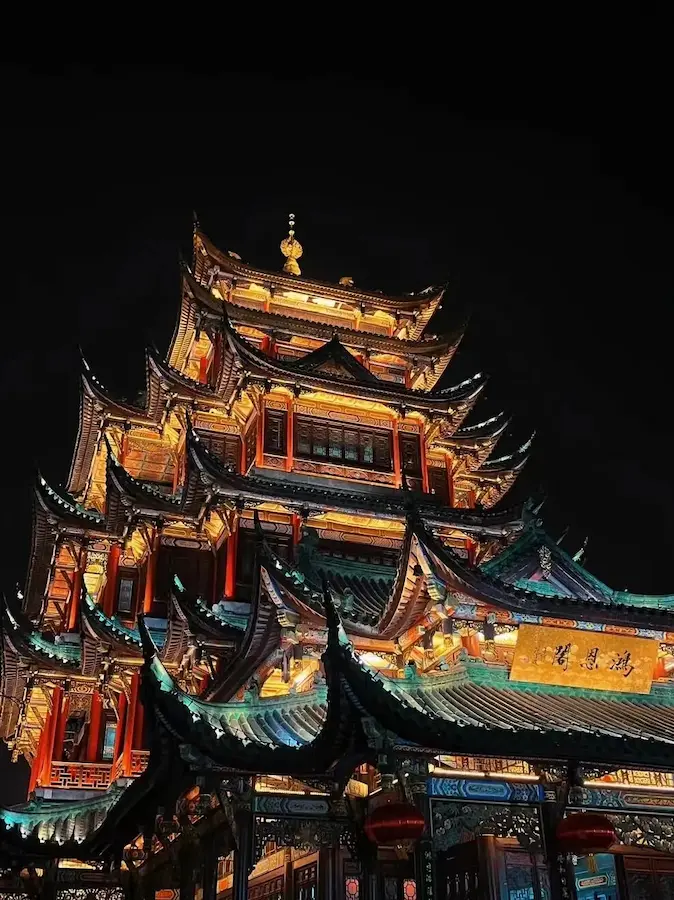
Think of it as a verbal visa. Getting the Chongqing pronunciation right won’t get you through customs, but it will get you through a hotpot order without the waiter guessing. It will get you to Hongyadong (洪崖洞) without the taxi driver squinting at you. Five minutes of practice. A whole trip made smoother.

Quick Breakdown: How to Pronounce Chongqing
Here’s the simplest version you can use right now:
/tʃɒŋˈtʃɪŋ/ — it sounds like “Chong-ching,” with the stress on the second syllable.
This is perfectly acceptable in everyday English conversation. Most travel vloggers and international media use this Chongqing pronunciation. But if you want to get closer to the real Mandarin sound, we need to bring in pinyin and tones.
Don’t worry. This is easier than it looks.
The Pinyin: Chóngqìng
Standard pinyin writes it as Chóngqìng. Those little marks above the vowels are not decoration — they’re pitch indicators. The same syllable spoken with a different tone means an entirely different word. This is the key to a correct Chongqing pronunciation.
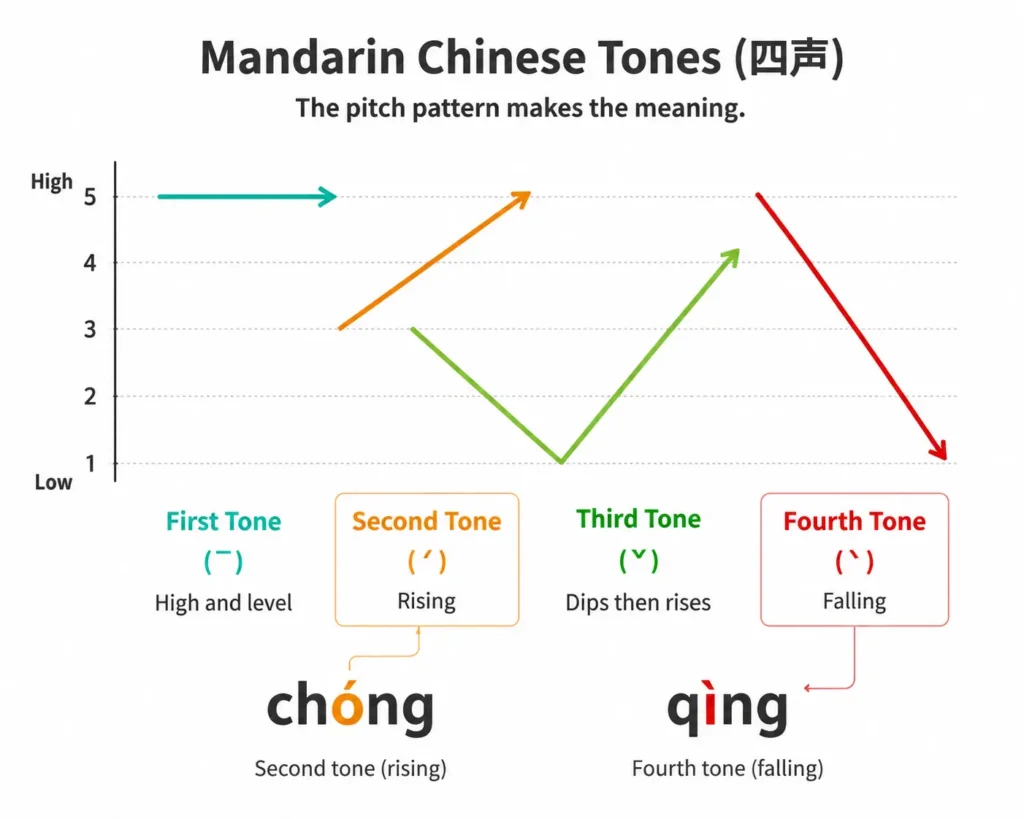
- chóng (Tone 2 ↗): Your voice rises from mid to high, like the upward lilt at the end of a question — “Huh? ↗”
- qìng (Tone 4 ↘): Your voice drops sharply from high to low, like a short, firm command — “Stop! ↘”
Syllable 1: “Chóng” (重)
The “ch” is close to English — think “church.” No trap there. But “ong” is where English instincts betray you.
Your brain wants to read it like the “ong” in “long” (/ɒŋ/). In pinyin, “ong” sounds closer to “oong” — as in the “oo” of “moon,” followed by “ng.”
Round your lips like you’re about to blow a whistle. Pull your tongue slightly back. Let the sound resonate deep in your chest: “Choong↗.”
Syllable 2: “Qìng” (庆)
This is the hard part. Pinyin “q” does not equal any single letter in English.
- ❌ Not the /kw/ in “queen”
- ❌ Not the /k/ in “king”
- ✅ It’s closer to English “ch,” but with your tongue flat and forward — tip behind your bottom teeth, the blade of your tongue pressing up against the roof of your mouth
Quick fix: pull the corners of your mouth into a wide, deliberate smile. Hold that smile. Now say “chee” (like the start of “cheese”) and glide it into “ng” — “chee-ng↘.”
That’s qìng.
Putting It Together
Say it with me: Choong↗ + cheeng↘ = Chóngqìng.
Hit play and practice the Chongqing pronunciation audio below. Listen once. Then say it three times. Let your mouth get used to the movement.
✅ Correct: /tʃɒŋˈtʃɪŋ/ (Chong-qing)
Chinese Tones Made Simple
English doesn’t have tones. (Not like this.) We use pitch for emotion — surprise, sarcasm, doubt — but never to distinguish one word from another. That’s why tones feel unnatural at first. Yet they’re the foundation of any accurate Chongqing pronunciation.
Here’s a cheat that works for Mandarin pronunciation beginners:
- Tone 2 (↗) sounds like you’re asking a question. “Chóng?” — the way your voice rises when you don’t quite believe someone.
- Tone 4 (↘) sounds like you’re giving an order. “Qìng!” — the way you’d say “No!” to a dog about to steal food off the counter.
When you chain them together — rising then falling — it creates a natural musical contour. Overdo it at first. Exaggeration is your friend. Subtlety comes later.
The Smile Technique: Lock In Your Chongqing Pronunciation Without Linguistics
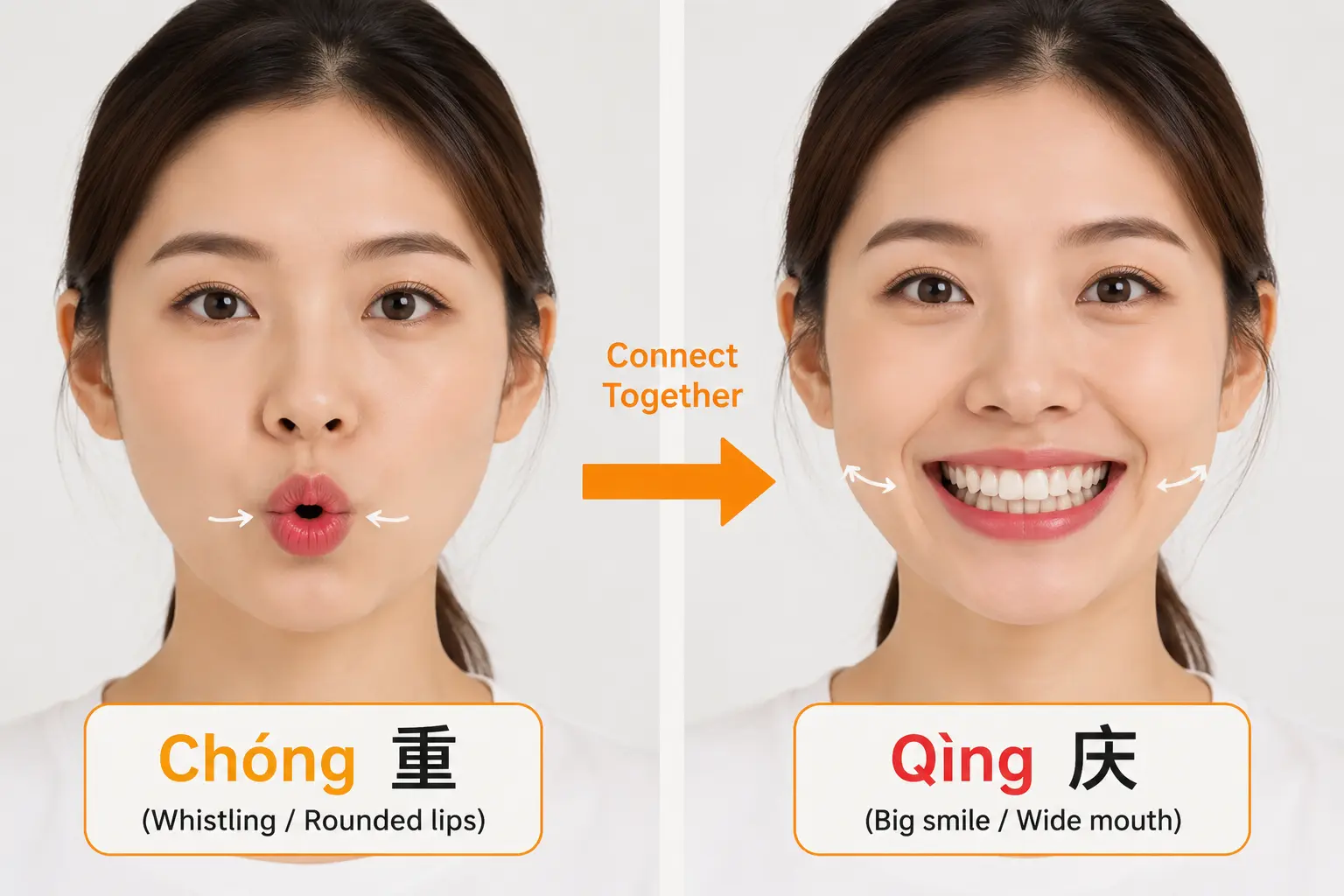
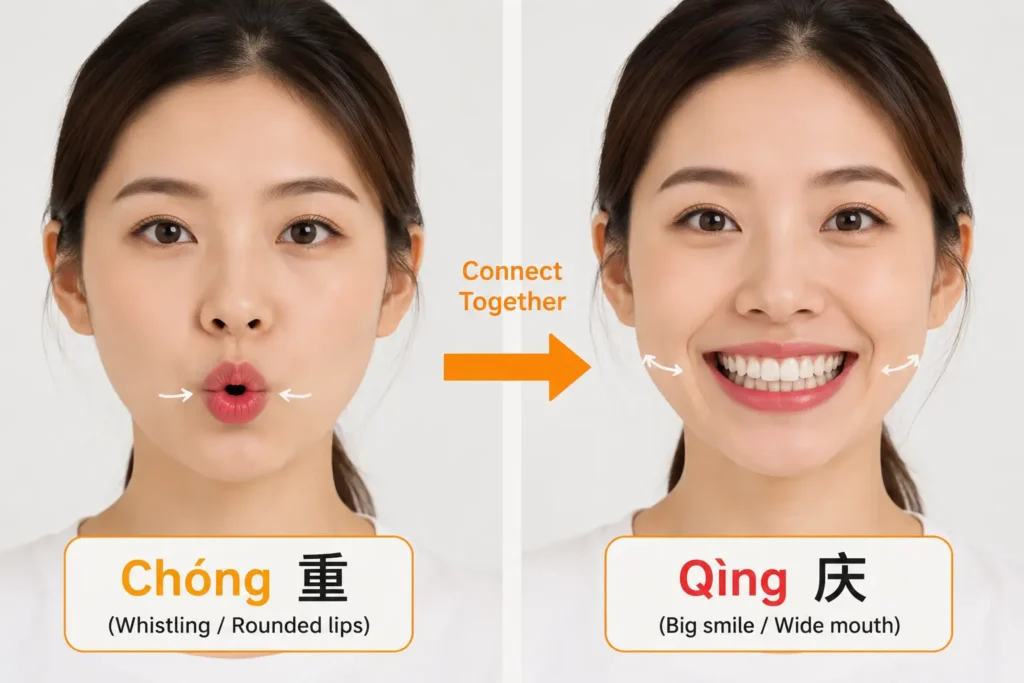
Forget IPA charts for a moment. Your face already knows what to do. Mastering how to pronounce Chongqing comes down to two simple mouth shapes.
Step 1: “Chong” — The Whistle Shape
Round your lips. Push them slightly forward — like you’re about to whistle or say “who.” Keep your tongue pulled back, resting nowhere in particular. The sound is deep, hollow, resonant. Almost exactly the English word “Chong,” but darker. Chooong↗.
Step 2: “Qing” — The Smile (This Is the One That Matters)
Stretch the corners of your mouth wide to the sides. A deliberate, exaggerated smile. Press the tip of your tongue against the back of your bottom teeth. With that smile locked in place, force a sharp burst of air between your tongue and the roof of your mouth. It comes out as “Chee” — the opening of “cheese” — sliding immediately into “ing.” Chee-ing↘.
💡 The Only Mnemonic You Need:
“Chong” = round lips (whistle). “Qing” = wide smile (teeth showing).
Stand in front of a mirror. Round. Smile. Round. Smile. Say “Chong + Chee-ing” as you do it. Hold the smile at the end.
You just produced a correct Chongqing pronunciation. (Probably for the first time in your life.)
Common Mistakes When You Pronounce Chongqing
Knowing what’s right is half the battle. Knowing what’s wrong — and why your brain keeps reaching for it — is the other half. Most Chongqing pronunciation errors follow predictable patterns.
❌ Mistake #1: “Chon-king”
This is the big one. English speakers see “qing” and their brain auto-completes to “king” — because “q” without “u” looks broken to us, and because “king” is a familiar pattern. The result: “Chon-king.”
Why it fails: “q” in pinyin has nothing to do with “k.” You’ve just turned 庆 (celebration) into something unrecognizable.
✅ Fix: Smile technique. Q = chee, not kee.
❌ Mistake #2: “Chong-queen”
Some brains refuse to accept “q” without “u,” so they shove a “u” in there anyway. Both syllables end up wrong.
✅ Fix: Delete “queen” from your mental file. Replace it with “cheen” (like “cheese” with an “n”).
❌ Mistake #3: Flat Tone, Zero Emotion
English has no lexical tones, so our default is to say everything at the same pitch. Your mouth position might be correct, but without that rising-falling contour, your Chongqing pronunciation sounds robotic to a native ear.
✅ Fix: Deliberately push your voice up on “Chong,” then slam it down on “Qing.” Exaggerate. No one ever got accused of being too enthusiastic while learning Chinese pronunciation.
❌ Common Mistake: “Chong-king” / “Shong-qing”
✅ Authentic: “Chong-qing”
What Does “Chongqing” Mean?
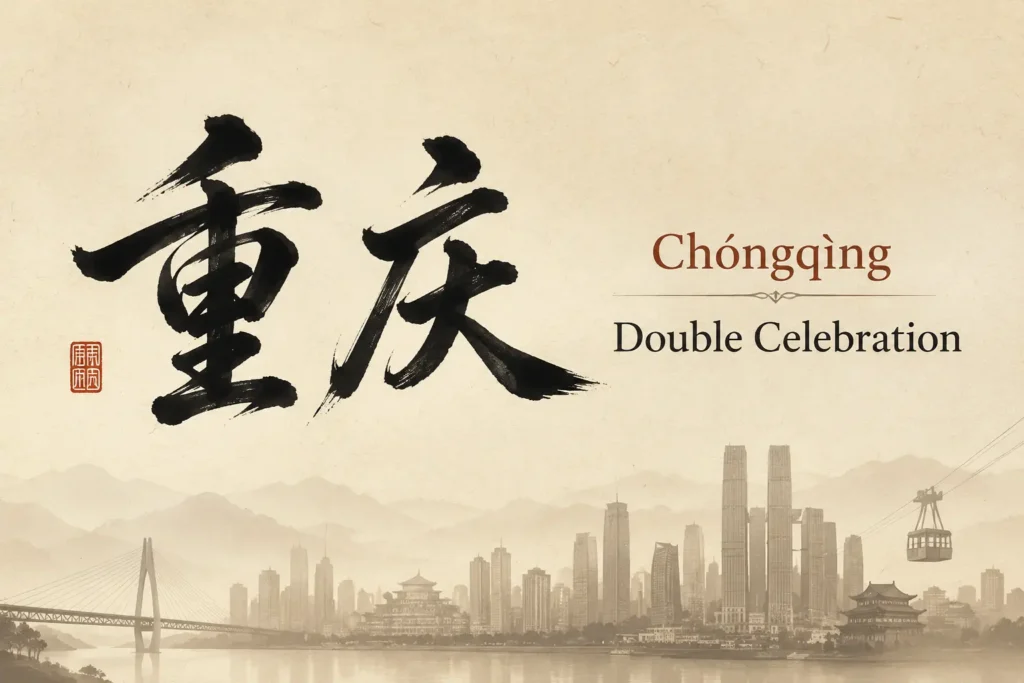
重 (chóng) = “double” / “again”
庆 (qìng) = “celebration” / “congratulate”
Put together: “Double Celebration.”
This is not a random lucky name. In 1189, during the Southern Song Dynasty, a man named Zhao Dun was first granted the title “Prince Gong” — a major life event. That same year, he ascended the throne and became Emperor Guangzong. Two seismic upgrades in twelve months. He decided he was, quite literally, experiencing “double celebration,” and renamed the prefecture from “Gong Prefecture” (恭州) to “Chongqing Prefecture” (重庆府).
The name has stuck for over 800 years.
Every time you say Chóngqìng with the correct Chongqing pronunciation, you’re speaking an emperor’s moment of pure euphoria. Not bad for two syllables.
The Two Chinese Characters: 重 (chóng) and 庆 (qìng)
If you see 重庆 written somewhere — a train ticket, a boarding gate, a restaurant sign — now you’ll know what you’re looking at. The first character (重) carries the idea of repetition and layering. The second (庆) carries the idea of festivity and joy.
Together, they capture something real about the city itself: layers upon layers of life, stacked vertically up the mountainsides, vibrating with an energy that feels celebratory even on a random Tuesday.
How Locals Say It: Dialect vs. Standard Mandarin
Walk through Chongqing’s streets and you’ll hear something slightly different from the textbook Chongqing pronunciation.
The local Chongqing dialect belongs to the Southwestern Mandarin family (西南官话). In the local tongue, “重庆” softens considerably — it sounds closer to “Cong-qin” (/tsʰoŋ²¹ tɕʰin²¹³/). The crisp, hard edges of standard Mandarin round off. Everything flows together more.
The Chongqing accent shares this quality: consonants feel less punched, vowels more drawn out. It’s a warm, rolling way of speaking that matches the city’s humid, unhurried river-town soul.
As a traveler, you don’t need to mimic the dialect. Standard Mandarin Chóngqìng works everywhere — hotels, restaurants, train stations. But recognizing the local sound will stop you from second-guessing yourself when you hear a different Chongqing pronunciation on the street.
(The official Chongqing language of administration and education is standard Mandarin, same as the rest of mainland China. Dialect is for home, street, and hotpot-table banter.)
Beyond Pronunciation: Why Book the Flight
You’ve got the Chongqing pronunciation down. Now: is Chongqing actually worth the trip?
This is not a “beautiful city.” This is a city that erupted out of a geological crack and never stopped growing. A monorail runs straight through the 19th floor of a residential building (Liziba Station). An apartment block has 24 stories and no elevator — but step out the 9th-floor exit and you’re standing on a street. The Yangtze and Jialing rivers collide at Chaotianmen, brown and green refusing to mix, a visible seam drawn across the water.
After dark, the stilt houses of Hongya Cave ignite in warm amber light, stacked precariously up the cliffside. Fans of Spirited Away recognize the scene instantly. Across the river, you drop onto a plastic stool at a sidewalk Chongqing hot pot joint. A copper pot boils furiously in front of you, swimming with Sichuan peppercorns and dried chilis. A meal runs about ¥80–150 CNY (roughly 11–21 USD). The first bite numbs your lips. Sweat beads at your temples. Your chopsticks do not stop moving.
Once you land, you’ll want a solid list of things to do in Chongqing — from riverfront walks to mountain day trips. But learning how to say Chongqing was step one. Step two is showing up.
FAQ
Is it “Chongqing” or “Chungking”?
Both — depending on the era. “Chungking” is the old postal romanization, widely used on Western maps and in pre-1950s media. Modern standard pinyin “Chongqing” has been the official form since 1958. If you encounter “Chungking” in an old film or book, it’s the same city. Pronunciation: /tʃʊŋˈkɪŋ/. In any modern context, stick with “Chongqing.”
How do you pronounce Chongqing in an English sentence?
In everyday English, /tʃɒŋˈtʃɪŋ/ (“Chong-ching”) is perfectly fine. Most international news outlets, YouTubers, and travel writers use this Chongqing pronunciation. It won’t win you a Mandarin fluency award, but it will get you understood in 99% of situations. If you want to impress, add the rising-falling tone contour on top of it.
Can I just say “Chong-ching” with flat tones?
Yes. You’ll be understood.
But — it’s like pronouncing “Paris” as “PAIR-iss.” A French person will know what you mean. Their ear will also twitch, just slightly. Getting the tones right isn’t survival. It’s respect. And in a city that welcomed 760,000 international visitors last year, nailing the Chongqing pronunciation is the thing that makes a local look at you and think: this one actually tried.
How to say Chongqing without embarrassing myself?
The one-sentence version: “Chong” like a whistle, “Qing” like a smile — rise then fall.”
Say it three times before you board the plane. That’s all the prep you need for a solid Chongqing pronunciation.
Your tongue knows the path now. Round lips, rising voice. Wide smile, sharp fall. Two shapes, one name.
Next time someone asks where you’re headed, you won’t have to spell it out. You’ll say Chóngqìng, and their eyes will light up.
That moment — the moment of being heard — tastes even better than the first slice of tripe out of a boiling hotpot.
Ke Ping — Founder, Chongqing Travels
Certified China Travel Specialist · Certificate details
This guide can become your real trip
Instead of figuring out the mountain city's vertical maze alone, let me and our team build your perfect Chongqing trip — from Hongyadong's neon lights to the best late-night hot pot.
📋 Plan My Chongqing Trip