Shibati Old Streets, Chongqing: Which of the 5 Zones Are Worth Your Time
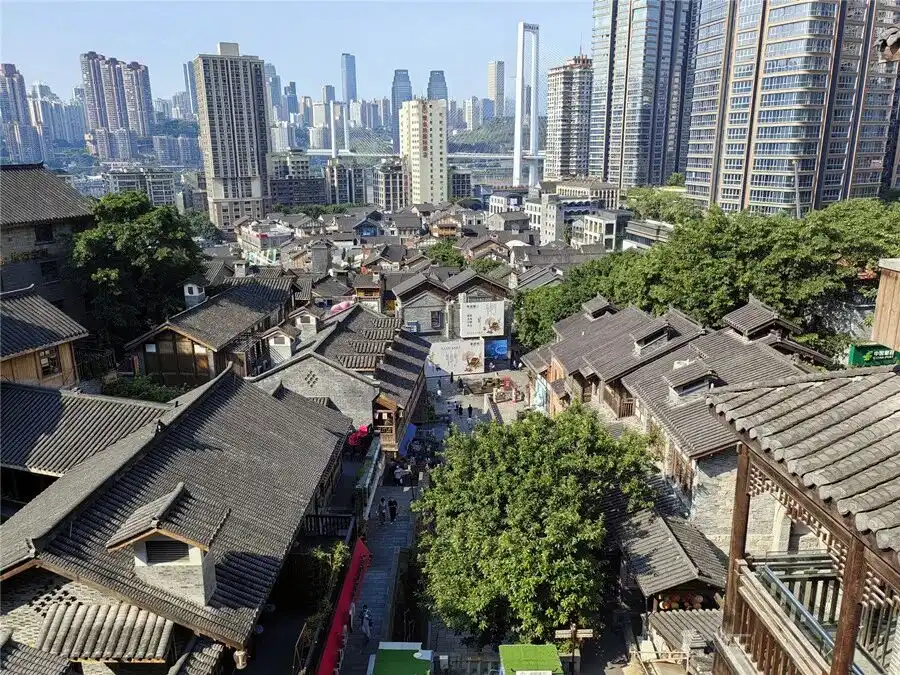
Stand on the city balcony at Jiaochangkou and the first thing that hits you is vertigo. Behind you, glass towers stretch toward Jiefangbei. Look down, and a blue-stone path drops straight through the gap between buildings, narrowing as it falls, until it sinks into the river fog of the lower city.
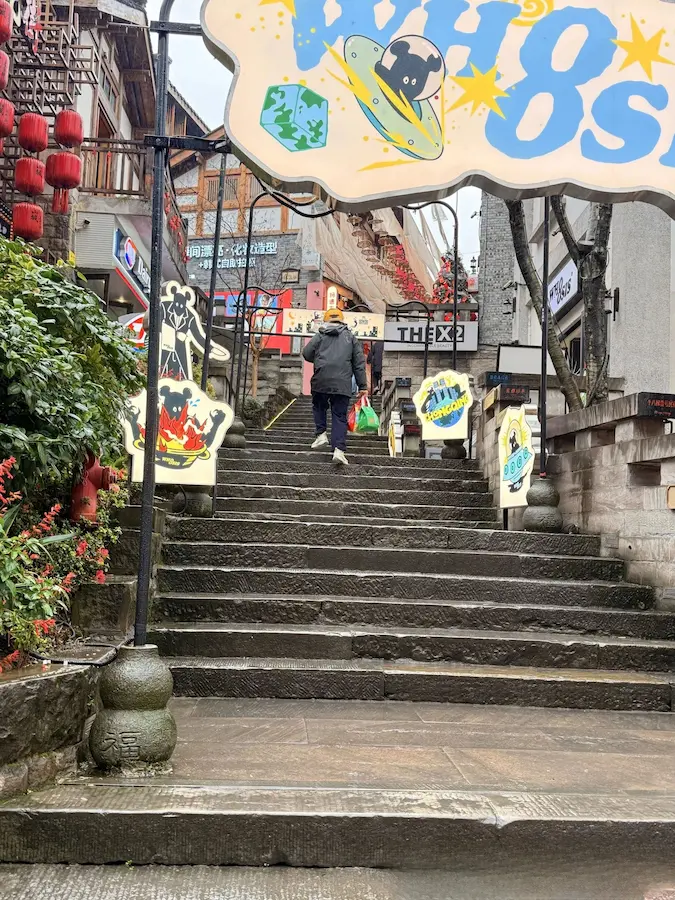
That path is Shibati Old Streets — a 400-meter, 200-plus-step stairway that splits Chongqing into its “upper city” and “lower city,” then stitches the two halves back together. It is one piece of Chongqing’s vertical mountain city, and it is the steepest, most photogenic way to feel that verticality on foot.
Most travelers to Chongqing end up choosing between three stops: Ciqikou, Hongya Cave, and Shibati. If you only have time to do one “old Chongqing” properly — and you don’t want a fake-antique street to eat half your afternoon — this guide tells you straight up whether it’s worth it, then walks you through the five zones, the timing, the food, and the right exit.
Is Shibati Old Streets Worth It? The Honest Answer
Short answer: yes. Shibati Chongqing is worth it — but know what you’re looking at.
Shibati Old Streets — officially the Shibati Traditional Style Area — is not an untouched old quarter. The official line is clear — six historic buildings, one heritage residence, and more than fifty reconstructed traditional-style buildings. In other words, the blue stone under your feet is real. Most of the houses lining it are newly built to look old.
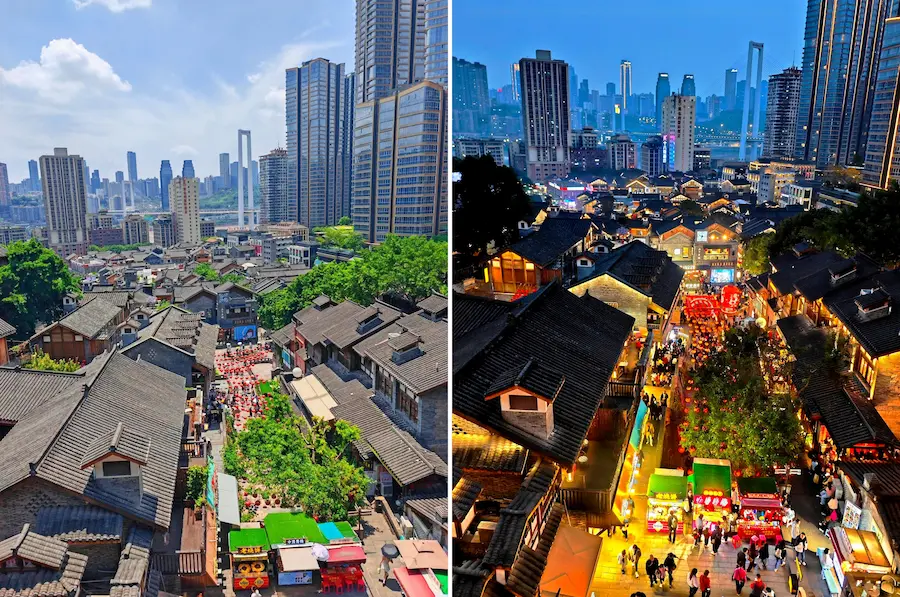
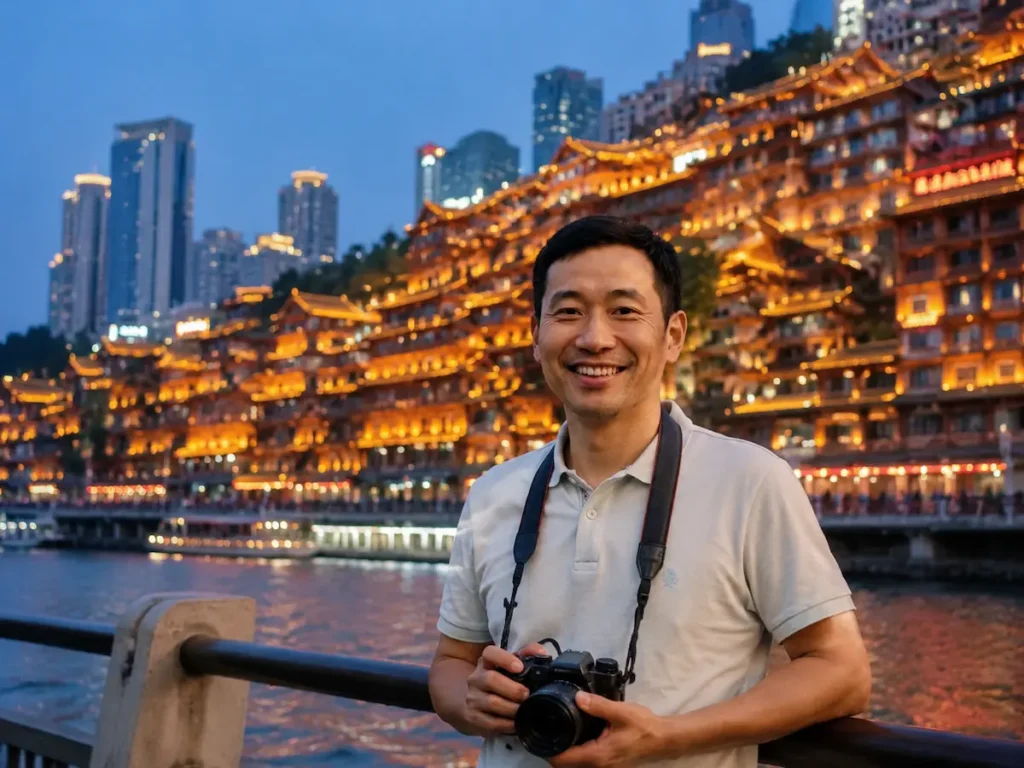
What makes Shibati Old Streets worth your time isn’t age. It’s steepness and contrast. By day you get blue stone, stilt houses, and steps dropping floor by floor. After dark, the red lanterns come on and the old eaves share a frame with the skyscrapers overhead. That shot — a slice of old time squeezed onto a mountainside — is something only Chongqing delivers.
If you want raw, original riverside atmosphere, go to Ciqikou Ancient Town instead (more on that below). If you want an easy, photogenic, Jiefangbei-adjacent piece of urban drama, Shibati Old Streets is the right call. Entry is free and the street is open all day; the museums and shops keep their own hours.
Why It’s 18 Flights, Not 18 Steps
You’ll see the name written a few ways — Shibati, Shiba Ti, Eighteen Stairs, and 18 Steps Chongqing (十八梯). They all point to the same place: Shibati Old Streets.
The name has two origins, both credible, and neither changes your visit. The first goes back to the Ming dynasty: near here there was an old well, and the path from the well to the main road was exactly eighteen steps, so people called the place “Shibati” — eighteen steps. That’s the “18 steps” in 18 Steps Chongqing.
The second says that in the Qing dynasty, locals split a long slope (they called it “Lanyangpo”) into eighteen sections, each with a small landing to rest on. Whichever story you prefer, 18 Steps Chongqing is really about sections, not a single staircase.
Either way, remember one thing: “18 steps” — or 18 flights — refers to eighteen sections, not eighteen actual stairs. What you actually climb in Shibati Chongqing (the place also known as 18 Steps Chongqing) is 200-plus steps. Don’t let the name trick you into thinking you’ll step off the train and be there.
Zones A–E: Which Ones Are Worth Your Time
Officially, Shibati Old Streets is split into five zones, A through E, grouped into four districts. Most people get halfway down and freeze: so many zones, what do I actually do? Skip the checklist. Pick by what you need.
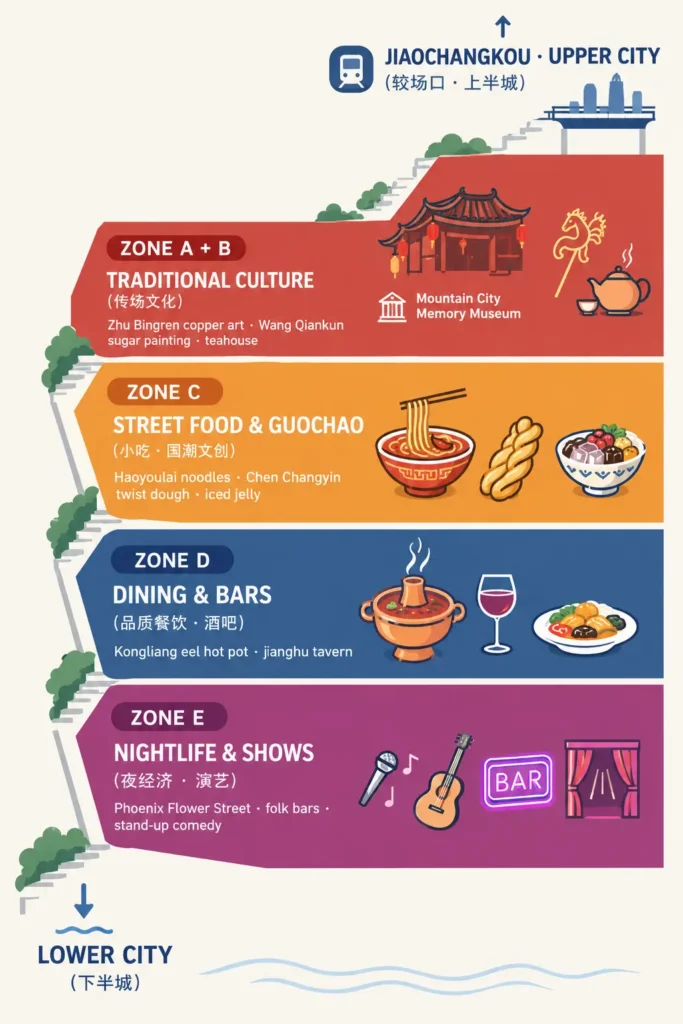
Zones A + B (Traditional Culture). This is the home of the intangible heritage and heritage brands — Zhu Bingren copper carving, Yudanfeng silverware, Wang Qiankun sugar painting, Lu Gaojian, plus more than twenty intangible heritage projects, stilt-house eaves, rows of red lanterns, a traditional teahouse or two, and the street-life scenes of old Chongqing. Want to feel “old Chongqing”? Linger in A and B. Don’t rush downhill.
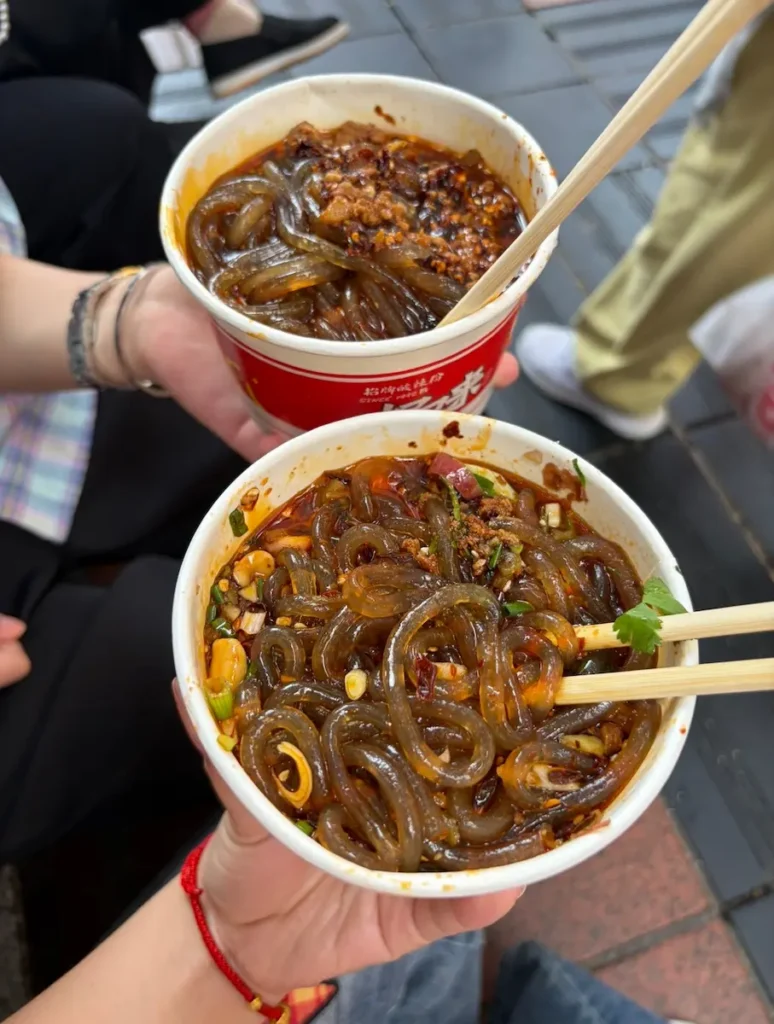
Zone C (Guochao Creative + Food). This is where you eat. Haoyoulai hot and sour rice noodles (about ¥12 / USD 1.7 a bowl), Chen Changyin twist dough (about ¥20 / USD 2.9 a bag), Deyuan sour plum drink, and the spice-killing iced tofu pudding and ice jelly (about ¥10 / USD 1.4) all cluster in Zone C, mixed with guochao creative shops. Meal time? Zone C.
Zone D (International Exchange / Trendy Life). Quality dining and bars. Jinxiaoshi super food factory, Kongliang eel hot pot, jianghu taverns. This is “sit down, eat properly, have a drink” territory, not street stalls.
Zone E (Lifestyle / Late-Night). Night economy and performance. Phoenix Flower Street runs 24 hours, and the folk-music bars (Dabing’s Cabin, Tangyao) and stand-up comedy theaters live here. Want to see how Chongqing people do nightlife? Come to Zone E after dark.
One-line version: by day, do A and B for old Chongqing; at meal time, hit C for snacks; for a proper sit-down meal, D; for nightlife, E. For first-timers, Zones A, B, and C are the must-visits. Save D and E for a full evening.
The museums and the memorial sit inside this layout, and they’re worth pausing for. The Mountain City Memory Museum (Shancheng) uses projections and dioramas to bring back the Chongqing that’s gone — a quick visual course in Chongqing history before you walk the steps. The Shibati Old Streets air-raid tunnel memorial — inside an actual bomb shelter, and free to enter like the street itself — tells the wartime story in four parts and ends with the city’s spirit of “getting stronger the more it was bombed” (愈炸愈强). It’s a memorial, not a photo-op. Keep your tone respectful.
16:00–22:30: A Timing That Actually Works
The thing to time isn’t opening hours. It’s the lights. Shibati Old Streets never closes, but it’s a different place before and after dusk.
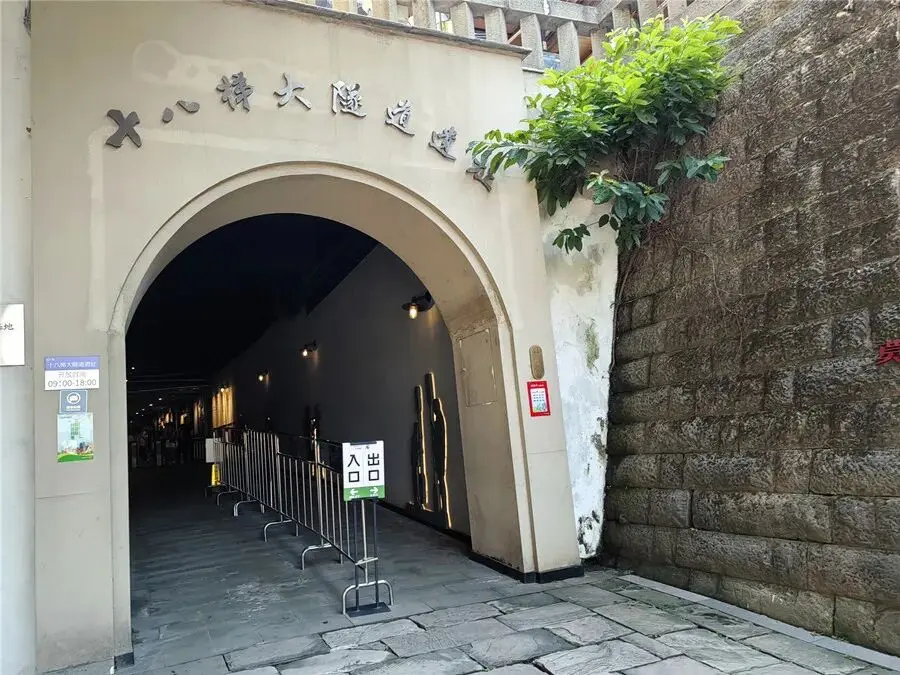
16:00–17:30, the tail of daylight. Come now for clean lines on the blue stone and stilt houses, soft light, no glare. The museums are still open — the Memory Hall runs 09:00–20:00, and the tunnel memorial 09:00–18:00 (last entry 17:30). If you want the museums, do this window first.
Around 18:30, the lights come on. Red lanterns switch on one by one. This is the golden moment to catch the day-to-night transition. From the entrance overlook you can frame the old street below against the modern towers above.
19:00–21:00, the best of it. All lights on, the most photogenic two hours. Also the busiest — be ready to shoot between crowds.
After 22:30, it dims. The main lights go down, and by 23:00 only basic lighting remains, with shops closing one after another. For the full night-view picture across the city, see our Chongqing at night guide; this page sticks to the timing, not the viewpoints.
Keep one distinction in your head: the street is 24 hours, the museums are not. The Memory Hall closes at 20:00; the tunnel memorial stops entry at 17:30 (check at the entrance — hours shift by season). If you want museums plus lights in one trip, arrive around 16:00, do the museums, then wait for dark.
Getting In: Jiaochangkou Exit 11
The metro is the easy route. Take Line 1 or Line 2 to Jiaochangkou Station and use Exit 11. It opens right onto the city balcony, the top entrance to Shibati Old Streets. This is the golden entrance — forget the old guides pointing you to Exits 3 or 4; those send you toward Jiefangbei and add a detour. For line details and fares, check our Chongqing metro guide.
By taxi, tell the driver “Shibati” or “No. 1 Zhongxing Road,” and ask to be dropped on the Jiaochangkou side. Walk downhill from the top. That’s the point — go high to low, don’t climb it in reverse.
Done here? Jiefangbei Pedestrian Street is about ten minutes on foot. For the Hongya Cave + Yangtze River Cableway night routes and viewpoint details, that’s a separate guide; this page sticks to Shibati Chongqing only.
Shibati vs Ciqikou vs Hongya Cave
If you can only do one, decide by what you want.
| Shibati | Ciqikou | Hongya Cave | |
|---|---|---|---|
| Location | Yuzhong District, steps from Jiefangbei | Shapingba District, ~30–40 min by metro | Yuzhong District, by Qiansimen Bridge |
| Terrain | Vertical stairway, upper–lower city drop | Riverside old port, gentle slope | Cliffside stilt-house complex |
| Draw | Night lights, old–new contrast, air-raid tunnels | Port culture, teahouses, Chen Ma Hua | Night-skyline icon, Qiansimen Bridge |
| Best for | Jiefangbei-adjacent, vertical-city shots | Original old town, half-day trip | One night photo, landmark check-in |
A one-line take: for old-city street life plus urban drama, Shibati Old Streets; for an original riverside old town and traditional snacks, Ciqikou; for one night-skyline photo to post, Hongya Cave. The biggest difference between Shibati and Ciqikou is this — Ciqikou is a real old town with plenty of original buildings, while Shibati is a reopened heritage district that’s mostly rebuilt. They do not smell the same.
Mistakes to Avoid
① Don’t expect an untouched old quarter. As said above, this corner of Shibati Old Streets is six old buildings plus fifty-plus reconstructions. Some visitors complain it feels “fake” or same-y, like other rebuilt streets. Set your expectations and you won’t be let down. Real old stone? Ciqikou.
② Don’t bring a suitcase or stroller. Two hundred-plus steep steps, all legs. Hard on seniors, kids, and wheeled luggage. Store your bags or come light.
③ Don’t come during a public holiday. Over Golden Week and summer peak, the narrow stairway goes shoulder-to-shoulder. Forget photos, turning around is the hard part. Off-peak if you can.
④ Don’t confuse museum hours with street hours. The street is open 24/7, but the Memory Hall closes at 20:00 and the tunnel memorial stops entry at 17:30. Come early if you want inside.
⑤ Don’t treat Shibati as a substitute for Hongya Cave’s night view. They’re different things — Hongya Cave glows as a building, Shibati glows as lanterns and street atmosphere. A “Hongya Cave + cableway” night run needs its own plan.
Quick Answers
Is Shibati Old Streets worth visiting?
Yes, if you want steep mountain-city texture, old–new contrast, and night lights — not if you want untouched old houses. For the latter, Ciqikou.
Is there an entrance fee?
No. Shibati Old Streets is free. Food, souvenirs, and some indoor exhibits cost extra.
Where is Shibati?
Shibati Chongqing sits in Yuzhong District — No. 1 Zhongxing Road, about a ten-minute walk from Jiefangbei. The top entrance is Jiaochangkou Station, Exit 11.
Is Shibati open at night?
Yes. The street is open 24/7, and the lanterns stay on until about 22:30 (dimming to basic lighting by 23:00). Shops and museums keep shorter hours.
When should I go?
Around 16:00 if you want the museums; around 18:30 if you only want the lights and night views, then stay until 21:00.
How long does it take?
1.5–2 hours for a quick walk; allow 3 hours to eat, shoot, and linger into the evening.
Shibati or Ciqikou?
Both if you have time (one downtown, one in Shapingba). One only? Choose by whether you want mountain-city drama or original old-town atmosphere.
Climb back up those 200-plus steps at the end and turn around. The stairway glows floor by floor, Jiefangbei’s towers hang overhead, and the old Chongqing beneath your feet is gone. Shibati Old Streets was never about how old any single building is — it’s about how a city turned its steepness into a way of life. That’s the honest verdict. Worth walking down for? That’s your call now. For more on how to build it into a full day, see our things to do in Chongqing guide.
Ke Ping — Founder, Chongqing Travels
Certified China Travel Specialist · Certificate details
This guide can become your real trip
Instead of figuring out the mountain city's vertical maze alone, let me and our team build your perfect Chongqing trip — from Hongyadong's neon lights to the best late-night hot pot.
📋 Plan My Chongqing Trip