18 Best Things to See in Chongqing: Downtown, Viewpoints & Day Trips
Chongqing doesn’t do subtle.
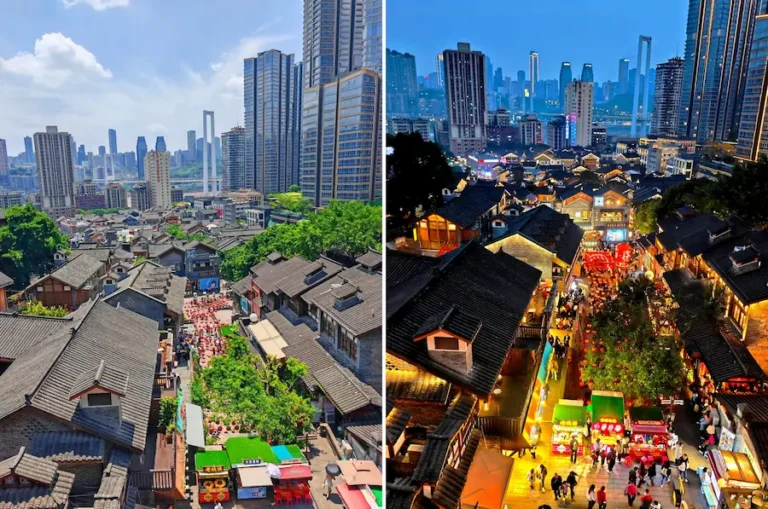
It’s a city where monorails burst through apartment blocks, where eleven-story stilt houses glow gold against the night sky, and where your GPS quits in confusion because the roads are stacked four layers deep. People ask what is Chongqing famous for — the short answer is everything in this paragraph. The longer answer is the next four thousand words.
This guide covers the essential things to see in Chongqing — the iconic skyline stops, the ancient streets, the mountain viewpoints, and the UNESCO day trips worth every minute of the journey. Consider it a handpicked shortlist of the best places to visit in Chongqing China, arranged by location so you can actually walk it. For a broader look at the city’s best activities beyond sightseeing, see our roundup of the best things to do in Chongqing. If you’re also working out where to stay, our guide to Chongqing hotels has area-by-area recommendations.
- What Makes Chongqing Unlike Anywhere Else
- Downtown Core: The Sights That Define the Skyline
- 1. Hongyadong — The Glowing Cliffside City
- 2. Jiefangbei & Bayi Food Street — The City's Beating Heart
- 3. Shibati (Eighteen Steps) — The Stairway Neighborhood
- 4. Shancheng Lane (Mountain City Trail) — Old Chongqing on the Hillside
- 5. Liziba Monorail Station — Train Through a Building
- 6. Yangtze River Cableway — The City From Above
- 7. Raffles City — The Crystal Sky Bridge
- 8. Chaotianmen Square — Where Two Rivers Collide
- Old Streets & Riverside Walks
- Viewpoints & Nature Inside the City
- Day Trips: UNESCO Sites & Hidden History
- Suggested Itineraries
- Practical Tips for Chongqing Sightseeing
- Frequently Asked Questions
What Makes Chongqing Unlike Anywhere Else
Before diving into the places to see in Chongqing, a word on why this city messes with your head (in the best way).
Chongqing sits at the confluence of the Yangtze and Jialing rivers, wedged into steep hills so aggressively that architects gave up on flat ground decades ago. The result is a vertical city. You’ll take an elevator to the 22nd floor, step out, and find yourself on another street. Car parks hover mid-building. Rooftops double as plazas. The locals call it 8D — four dimensions aren’t enough to describe the geometry here. There are more chongqing things to see per square kilometer than almost any city in China, and half the fun is getting lost between them.
It’s also massive. Thirty-two million people live in the municipality (the city core holds about 9 million). The skyline stretches for kilometers in every direction, and when fog rolls in — which it does, often — the skyscrapers float above the mist like something out of a sci-fi film. Nobody planned for the china mountain city to become a cyberpunk icon. The terrain made it inevitable.
Pack comfortable shoes. You’ll thank me after the first three hundred stairs.
Downtown Core: The Sights That Define the Skyline
These are the things to see in Chongqing that fill every Instagram feed and travel documentary. They’re clustered in Yuzhong District — the peninsula between the two rivers — and most are within walking distance of each other.
1. Hongyadong — The Glowing Cliffside City
This is the one. The postcard. The reason half the internet now knows Chongqing exists.
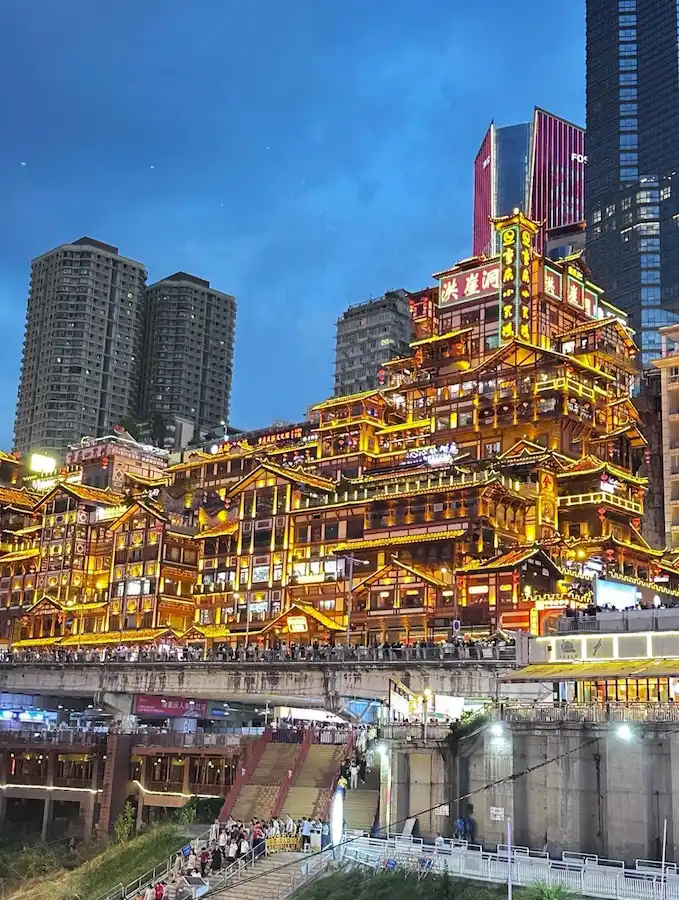
Hongyadong is an eleven-story complex of traditional Bayu stilt houses (diaojiaolou) pinned to a cliff above the Jialing River. By day it’s handsome. By night, when warm lights bathe every wooden eave, it looks like the bathhouse from Spirited Away materialized in southwest China. Even jaded locals pause to look. Read our dedicated guide to Hongya Cave Chongqing for a deeper dive into tickets, best photo spots, and what to skip.
Floor guide (top to bottom):
- 11F (Cangbai Road entrance): Panoramic viewing platform overlooking the Jialing River and Qiansimen Bridge.
- 9F–10F: Rooftop cafés and bars — grab a drink and watch the lights come on across the river.
- 5F–8F: Folk culture zone and “Reunion 1980” retro block (Sichuan face-changing performances, vintage shops).
- 4F: Indoor food street and a small square with a second river-view platform.
- 1F (Jiabin Road): Exit to the riverside. Cross the street for the classic full-width photo of Hongyadong.
Admission: Free (WeChat mini-program reservation required). Lights on: roughly 19:00–23:00, seasonal adjustments possible. Metro: Xiaoshizi Station (Line 1 or 6), Exit 9, 10-minute walk.
Don’t: Pay anyone offering “fast-track” tickets. There’s no such thing. Do: Walk onto Qiansimen Bridge after sunset. The view from the middle of the bridge — Hongyadong glowing on your left, the river below, the skyline ahead — is one of the most memorable things to see in Chongqing, and it costs nothing. If you love the city after dark, you’ll find more inspiration in our guide to Chongqing at night.

2. Jiefangbei & Bayi Food Street — The City’s Beating Heart
The Liberation Monument (Jiefangbei Chongqing) stands at the center of the city’s busiest commercial district — a granite tower built in 1947 to commemorate victory in the War of Resistance. These days it’s surrounded by glass malls, luxury hotels, and a constant stream of pedestrians. It’s not a “sight” in the traditional sense. It’s the city’s living room.
More importantly, it’s fifty meters from Bayi Food Street. This pedestrian lane is a sensory ambush: grilled squid smoke, chili-oil vats bubbling, vendors shouting orders over each other. Try the sour-spicy sweet potato noodles (suanlafen, about ¥10 / USD 1.50), the chilled glutinous rice balls in sweet soup (bing tangyuan), and anything on a stick being grilled right now.
Metro: Jiaochangkou (Line 1 or 2) or Linjiangmen (Line 2).


3. Shibati (Eighteen Steps) — The Stairway Neighborhood
A ten-minute walk from Jiefangbei, Shibati is a slice of old Chongqing stitched into the modern city. The name means “eighteen steps,” though there are far more than eighteen. What you get is a restored hillside neighborhood of stone stairways, grey-brick courtyard houses, and narrow lanes that climb the slope between Jiaochangkou and the river. Vendors sell ice jelly (bingfen) from doorways. Elderly residents play cards on folding stools. A few modern cafés and craft shops have moved in, but the bones are still Qing Dynasty. Come in the late afternoon — the light rakes across the old walls and the stairways fill with long shadows. Free. Open all hours.
4. Shancheng Lane (Mountain City Trail) — Old Chongqing on the Hillside
While Shibati is vertical, Shancheng Lane is horizontal — a restored cliffside path running along the Yuzhong hillside with views over the Yangtze River. Start from Lingshi Xiang (Consulate Lane) near Qixinggang Metro Station (Line 1). This is the top of the trail. Walk downhill — always downhill in Chongqing when you have the choice — past preserved stone walls, small teahouses, and Qing Dynasty-era buildings reborn as indie galleries and craft shops. The path eventually connects to the newer sections near the river. Budget about 90 minutes at a relaxed pace.
Among chongqing things to see that fly under the radar, this path delivers a quieter kind of magic. Free.
5. Liziba Monorail Station — Train Through a Building
You’ve seen the video. Now stand underneath it.
Metro Line 2 passes directly through the 6th to 8th floors of a residential apartment block at Liziba Station. The city didn’t want to demolish the building. The building’s residents didn’t want to move. So the train goes through it. This is the kind of logic that makes Chongqing sightseeing feel like exploring a video game level — and one of those chongqing things to see you simply can’t find anywhere else on earth.
Photo spot: The viewing platform at the base of the building. Aim up. Wait for the train. Pro move: Ride Line 2 between Liziba and Fotuguan for a few stops — the river views from the elevated tracks are spectacular. Then exit and photograph from below.
Nearby: Eling Creative Park (a former printing factory turned arts district, cafés, galleries, and city views from the upper terrace) is a short walk or taxi ride away.

6. Yangtze River Cableway — The City From Above
Before bridges and metro lines, this cable car was how people crossed the Yangtze. Now it’s a four-minute float above the river with a view of the entire Yuzhong Peninsula. Sunset rides are the sweet spot: daylight for the cityscape, then the first lights flickering on as you reach the north bank. Among downtown places to see in Chongqing, this one delivers the broadest perspective — a moving panorama of both rivers, the bridges, and the stacked skyline.
Hours: 7:30–21:30 (extended on holidays). One-way: ¥20 (about USD 3). Round-trip: ¥30 (about USD 4.30). One-way is usually enough unless you’re staying on the south bank.
Queue hack: Board from the south bank (Shangxinjie Station) heading north. The south-side station typically has far shorter lines than the north (Xinhua Road). Book your slot via the “Chongqing Cableway” WeChat mini-program. Without it, weekend waits can stretch past an hour.

7. Raffles City — The Crystal Sky Bridge
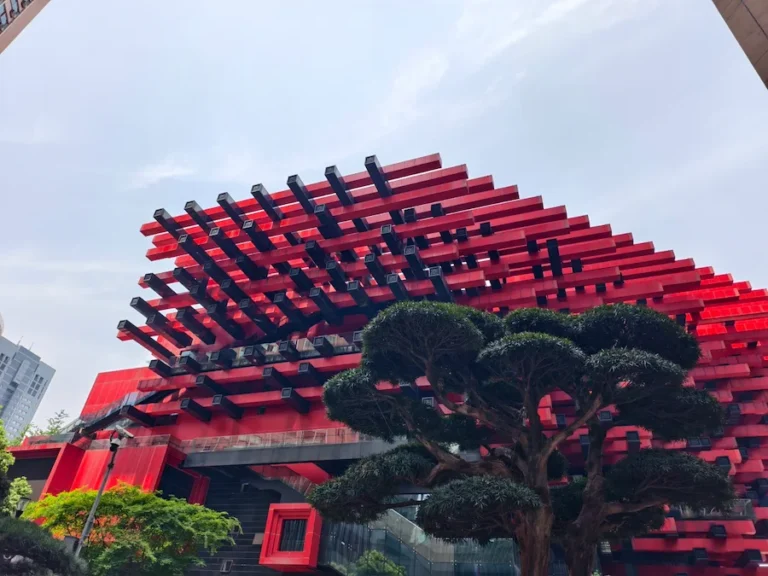
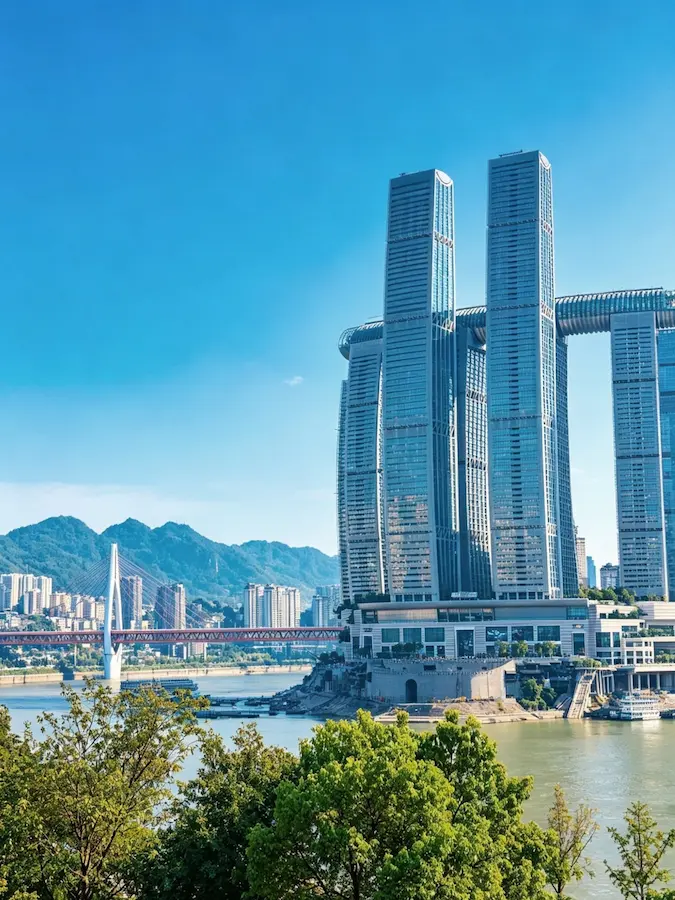
Raffles City is impossible to miss. The eight-tower complex, connected by a 300-meter sky bridge (the “Crystal”), rises above the Yuzhong Peninsula at the tip of Chaotianmen. Designed by architect Moshe Safdie, the horizontal bridge sits 250 meters above the ground and links four of the towers. Inside the mall, take the elevator to the observation deck for a straight-down view of the river confluence. Free to enter the mall itself. The sky bridge observation deck (Cloud Eye) charges a separate ticket — around ¥180 (about USD 26). Even from the ground, the sheer scale of the complex is worth seeing. It’s one of those things to see in Chongqing that defines the modern skyline.
8. Chaotianmen Square — Where Two Rivers Collide
Right beneath Raffles City, Chaotianmen Square spreads across the very tip of the Yuzhong Peninsula. This is where the brown Yangtze and the green Jialing rivers meet — a visible seam of color that stretches downstream for several hundred meters before the waters fully blend.
The square itself is a massive public plaza, open 24 hours, free, and popular with locals flying kites in the late afternoon. Walk to the railing at the edge and stare down at the confluence. On a clear day you can see the Nanshan ridge across the water. For a closer look at the square’s history and layout, see our guide to Chongqing Chaotianmen Square. This whole riverfront stretch is easily one of the most dramatic things to see in Chongqing for photographers and first-time visitors alike.
Old Streets & Riverside Walks
The neon skyline gets the headlines, but the Chongqing tourist places that stick with you longest are often the quiet ones — riverfront lanes, restored Qing-era streets, and neighborhoods where the city slows down.
9. Ciqikou Ancient Town — A Thousand Years by the River
Ciqikou was a porcelain trading port on the Jialing River during the Ming and Qing dynasties. The flagstone streets, wooden shopfronts, and hanging red lanterns remain — though these days the porcelain shops share space with mahua (fried dough twist) vendors and Sichuan opera teahouses. It remains one of those chongqing things to see that bridges the city’s past and present in a single walk. For an even deeper exploration, bookmark our full guide to Ciqikou Ancient Town Chongqing.
It gets crowded. Go before 10:00 AM on a weekday if you can. The back lanes — away from the main drag — still feel like old river-town China: elderly residents playing mahjong in doorways, laundry strung across alleys, the smell of pickled vegetables drifting from kitchens.
Eat: Chen Mahua (crispy twisted dough, ¥10–15 / USD 1.50–2), hand-pulled maoxuewang (blood curd stew), and sour plum drink. Buy: A block of Chongqing hot pot base as a souvenir. Metro: Ciqikou Station (Line 1).

10. Xiahaoli & Longmenhao — Restored Riverfront Lanes
These two adjoining old streets on the south bank have been restored in recent years without (thankfully) being turned into a mall. Old stone houses now hold indie coffee shops and craft stores. Narrow stairways drop toward the river. By late afternoon, the light hits the facades and the Yuzhong skyline emerges across the water.
Walk through Xiahaoli first, then follow the path along to Longmenhao. Together they take about two hours at a relaxed pace. The area is especially good at dusk — the city lights across the river start blinking on while the streets stay quiet. These aren’t the flashiest chongqing things to see, but they’re the ones you’ll remember.
11. Two Rivers Ferry — The Cheapest River Cruise in Town
Forget the expensive Yangtze cruise boats. The public ferry connecting Ciqikou to Dazhulin on the Jialing River costs ¥10 (about USD 1.50) and gives you a full panorama of the riverbank from water level. Two other routes serve the downtown core:
- Hongyadong ↔ Ciqikou: ¥40 (about USD 6), 60–70 minutes, connects two of the city’s most famous sights.
- Two Rivers Ferry (Hongyadong ↔ Jiangbeizui ↔ Danzishi): ¥15 (about USD 2), short hop across the confluence zone.
Boats can pause or cancel during heavy fog, high water, or low-water seasons. Check the “重庆交运两江游” WeChat mini-program for real-time schedules. Buy tickets at the dock.
12. Zhongshan 4th Road — Chongqing’s Most Beautiful Street
This tree-lined avenue in Yuzhong District was once home to diplomats, wartime leaders, and republican-era officials. The plane trees arch overhead. The buildings — colonial, art deco, traditional Chinese — hold museums (Guiyuan, Zhougong Mansion, the China Democratic Parties History Museum). Most are free.
Start at Niujiaotuo Metro Station (Line 2 or 3). Walk east along Zhongshan 4th Road toward Zengjiayan Station. The whole stretch is about 1.5 kilometers. Go in the late afternoon — the light filters through the trees, cafés spill onto the pavement, and it’s one of the few chongqing landmarks that feels genuinely peaceful.
At the eastern end, near Zengjiayan, the Cliffside Path drops down toward the Jialing River. Walk it at dusk for the river lights.
Viewpoints & Nature Inside the City
13. One Tree Hill (Yikeshu) — The Best Skyline Panorama
For the definitive Chongqing panorama, head to One Tree Hill (Yikeshu) on Nanshan. The viewing platform faces the Yuzhong Peninsula head-on: the two rivers sweeping around it, the skyscrapers lit up in sequence, the bridges strung with LEDs. Come at sunset and stay until dark — the transition is the whole point. The platform fills up fast in the hour before dusk, so arrive early to claim a front-row spot.
Admission: ¥30 (about USD 4.30). Getting there: Taxi or DiDi, about 30 minutes from Jiefangbei. No metro to Nanshan itself. Budget ¥40–60 (about USD 6–9) each way. Combine with the Huangge Trail earlier in the day for a full Nanshan outing that covers the best things to see in Chongqing from above.

14. Huangge Trail & Lao Jun Cave — Forest and Taoist Temple
A quieter side of Nanshan, and a world apart from the One Tree Hill crowds. The Huangge Ancient Trail is a stone-paved footpath that climbs through dense old-growth forest — camphor trees, yellowhorn maples, and the namesake huangge (strangler fig) whose aerial roots drape across the path like curtains. The climb takes about 40 minutes at a steady pace.
At the top sits Lao Jun Cave, a Taoist temple complex built into the mountainside, with incense drifting from prayer halls and a panoramic terrace looking west toward the city. The temple dates to the Tang Dynasty, though most of the current structures are Qing-era reconstructions. Admission to the trail is free; the temple asks for a small donation (¥10 / about USD 1.50). Go in the morning — the forest shade keeps the path cool, and the temple is at its most serene before the afternoon visitors arrive.
Day Trips: UNESCO Sites & Hidden History
These are the places to see in Chongqing that require a car, a train, or a tour. By now you’ve covered the core Chongqing places of interest inside the city — what follows takes you further out. Each is a full-day commitment. Each is worth it.
15. Wulong Karst — Natural Bridges & Sinking Gorges
Two and a half hours southeast of the city, the Wulong Karst landscape does things to rock that shouldn’t be geologically possible. The Three Natural Bridges — Tianlong, Qinglong, and Heilong — are massive limestone arches spanning a deep gorge. You enter via an elevator shaft sunk into the cliff face, then walk the gorge floor beneath arches so vast they were used as a filming location for Transformers 4.
Next door, the Longshuixia Fissure is a narrow canyon with waterfalls cascading from both walls. The path is long (knee protection advised). Combine both for a full day.
Getting there: High-speed train from Chongqing North to Wulong Station (about 2 hours, ¥25 / USD 3.60), then a shuttle bus to the scenic area. Or join a tour. Admission: Three Bridges ¥125 (about USD 18); combined ticket with Longshuixia Fissure around ¥200 (about USD 29).
If you stay overnight, Fairy Mountain (Xiannüshan) — a high-altitude grassland — offers cool summer escapes and winter skiing. Budget-wise, for a full overview of what a trip here costs, see our breakdown of how expensive is Chongqing — day trips, meals, and transport included.

16. Dazu Rock Carvings — 1,000 Years in Stone
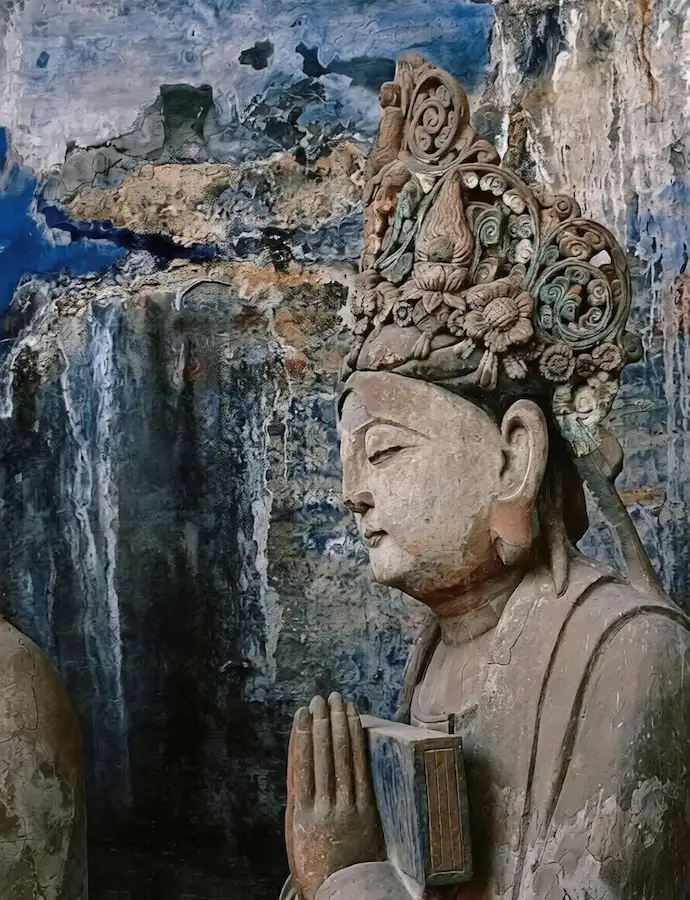
About 1.5 hours west of the city, the Dazu Rock Carvings are a UNESCO World Heritage site containing over 50,000 Buddhist, Taoist, and Confucian figures carved into cliff faces between the 9th and 13th centuries. Unlike the imperial grandeur of the Longmen or Yungang grottoes, Dazu feels intimate — scenes of daily life, parenting, punishment, and redemption carved with startling realism. The Thousand-Hand Guanyin alone, with over 1,000 gilt hands radiating behind a serene figure, justifies the trip.
Getting there: High-speed train from Chongqing West to Dazu South Station, then a shuttle bus to the Baoding Mountain site. Or drive (1.5 hours). Admission: ¥135 (about USD 19). Tip: An audio guide or live guide transforms the experience — the carvings tell stories you won’t decode on your own. For a deeper dive, see our full guide to the Dazu Rock Carvings Chongqing. Among cultural things to see in Chongqing, this UNESCO site is nothing short of essential.

17. Three Gorges (Fengjie & Wushan) — Poetry Made Landscape
The Yangtze’s Three Gorges begin where Chongqing municipality meets Hubei province. Baidi City in Fengjie perches at the entrance to Qutang Gorge — the narrowest, most dramatic of the three. Its image appears on the back of China’s ¥10 note. Ancient poets wrote about this spot. The cliffs still rise four hundred meters straight out of the water.
Further downstream in Wushan, the Lesser Three Gorges — narrower tributaries of the main river — deliver emerald water, hanging coffins, and mist-draped peaks. A small boat navigates the gorges for about four hours.
How to visit: A 2–4 day Yangtze cruise departing from Chaotianmen Pier is the classic approach. For shorter trips, take a high-speed train to Fengjie or Wushan (about 1.5–2 hours) and arrange local boat tours. These are some of the grandest places to see around Chongqing — not quite day trips, but easily the most memorable extension to a Chongqing itinerary. If you have a week, our Chongqing 7-day itinerary weaves the gorges into the full experience.

18. 816 Project — The Underground Nuclear City
Buried inside a mountain in Fuling District, about 1.5 hours from downtown, sits one of the strangest things to see in Chongqing: a decommissioned Cold War-era nuclear facility. For eighteen years, over 60,000 workers hollowed out the mountain to build a plutonium processing plant. The outside world knew nothing of its existence until it was declassified in 2002.
Today you can walk through the vast man-made caverns — tunnels tall enough for trucks, control rooms frozen in the 1970s, reactor halls carved into the rock. It’s part engineering marvel, part ghost story. The temperature inside stays around 20°C year-round (bring a jacket). Admission: ¥60 (about USD 9). Tours run in Chinese; English audio guides are sometimes available at the entrance.
Combine with a visit to the nearby Baiheliang Underwater Museum (ancient hydrological inscriptions visible through glass tunnels below the Yangtze) — together they make a full, deeply unusual day.

Suggested Itineraries
3-Day Highlights (First-Timer’s Perfect Weekend)
Day 1 — Downtown Core: Jiefangbei → Bayi Food Street (lunch) → Shancheng Lane (afternoon stroll) → Raffles City + Chaotianmen Square (river confluence view) → Hongyadong at night. Walk onto Qiansimen Bridge for the final photo.
Day 2 — Old Streets & Views: Ciqikou Ancient Town (morning, before crowds) → Two Rivers Ferry to Hongyadong → Liziba Monorail (afternoon) → Shibati in the late light → taxi to Nanshan One Tree Hill for sunset and night panorama.
Day 3 — Day Trip: Choose Wulong Three Bridges (nature) or Dazu Rock Carvings (culture). Return to the city for a final Chongqing hot pot dinner.
5-Day Deep Dive
Days 1–3: Follow the 3-day itinerary above.
Day 4: Zhongshan 4th Road morning walk → Three Gorges Museum (free, 3 hours — see our Three Gorges Museum guide) → lunch on Zhongshan 4th Road → Huangge Trail & Lao Jun Cave (afternoon hike) → Xiahaoli & Longmenhao old streets in the evening light.
Day 5: 816 Project + Baiheliang Underwater Museum in Fuling, or a second day trip to whichever of Wulong/Dazu you skipped. For a more relaxed final day, stay in town and explore Eling Creative Park and Guanyinqiao’s food streets.
Practical Tips for Chongqing Sightseeing
- Metro is your friend. Lines 1, 2, 3, 6, and the Loop line cover most things to see in Chongqing downtown. The Chongqing metro map shows every stop mentioned in this guide. Single rides ¥2–7 (about USD 0.30–1).
- Navigation apps lie here. When your map says you’ve arrived but the destination is nowhere, look up. Or down. The city is vertical — your restaurant might be on the 20th floor of the building whose lobby you’re standing in. Switch your map to walking mode, and when in doubt, ask a young local.
- Wear shoes you can walk ten kilometers in. Chongqing sightseeing involves stairs. Many stairs. Then more stairs. Heels are a tactical error.
- Best seasons: Spring (March–May) and autumn (September–November). Summers hit 38°C and high humidity. Winters are mild but foggy (expect moody photos, not blue skies). Check our guide to the best time to visit Chongqing for a month-by-month breakdown of the weather.
- Book ahead. Yangtze Cableway, Hongyadong (free but reserve via WeChat), Wulong, and Dazu all benefit from advance tickets. Peak holidays (National Day, Spring Festival) fill everything.
- Payments: Alipay and WeChat Pay dominate. Cash is accepted but rare. International cards work at hotels and larger restaurants, less so at street stalls.
- Hongyadong touts: Ignore anyone offering “fast-track entry” or “best photo spots.” Both the entrance and the best views are free and self-evident.
Frequently Asked Questions
How many days do I need in Chongqing?
Three full days covers the downtown highlights and one day trip. Five days lets you add a second day trip, the museum, the old streets, and the 816 Project at a more relaxed pace. The city rewards slow exploration — the things to see in Chongqing multiply the longer you stay.
Is Chongqing worth visiting?
Yes. There is no other city on earth that looks or feels like this one. The combination of vertical architecture, river landscapes, spicy food culture, and sci-fi skyline is completely singular. First-time visitors to China often skip Chongqing for Beijing or Shanghai — and they miss the most visually astonishing city in the country.
What is the best area to stay in?
Jiefangbei / Hongyadong area (Yuzhong District) puts you within walking distance of half the places to see in Chongqing on this list. For quieter stays, Nanbin Road on the south bank offers river-view hotels and easy access to Nanshan. Our Chongqing hotels guide breaks down the best areas in detail.
Can I visit Chongqing without speaking Chinese?
Yes, but it requires more preparation than Beijing or Shanghai. Download a translation app (Baidu Translate works offline), set up Alipay with your international card before arriving, and save your hotel address in Chinese characters. Metro signs and major attractions have English labels. Smaller street restaurants won’t — point at what the next table is eating.
Is Chongqing safe for tourists?
Very. Violent crime is rare. The biggest risks are heatstroke in summer, slippery stairs in the rain, and underestimating how spicy the hot pot is. See our guide on whether Americans can visit Chongqing for visa and entry details.
Chongqing doesn’t do subtle — but it also doesn’t do shallow. Every set of stairs, every river bend, every narrow alley between skyscrapers has a story. You came for the cyberpunk skyline. Stay for the thousand-year-old carvings, the underground nuclear city, and the hot pot that makes your lips go numb in the best possible way. These best places to visit in Chongqing China will keep you busy — and probably a little sore in the legs. However many chongqing things to see you check off, leave room for the ones you’ll stumble into by accident. The mountain city has been waiting.
Ke Ping — Founder, Chongqing Travels
Certified China Travel Specialist · Certificate details
This guide can become your real trip
Instead of figuring out the mountain city's vertical maze alone, let me and our team build your perfect Chongqing trip — from Hongyadong's neon lights to the best late-night hot pot.
📋 Plan My Chongqing Trip